About Chlorophytum comosum (Thunb.) Jacques
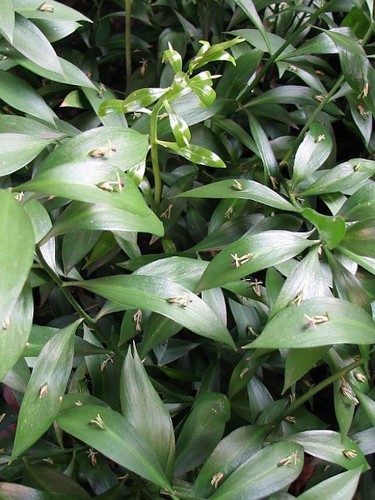
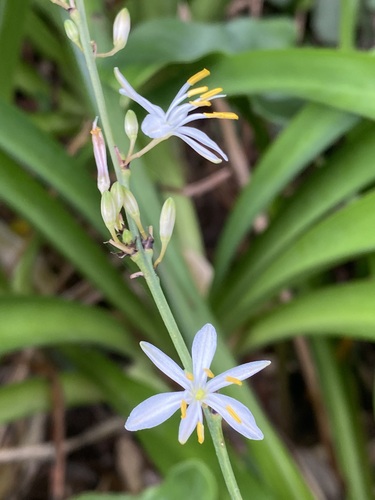
Chlorophytum comosum (Thunb.) Jacques typically grows to around 60 cm (24 in) tall, but when grown as a hanging plant, its foliage and stems can descend many feet. It has fleshy, tuberous roots, each 5–10 cm (2–4 in) long. Its long, narrow leaves grow 20–45 cm (8–18 in) in length and 6–25 millimetres (0.2–1.0 in) wide. Flowers are produced on a long, branched inflorescence that can reach up to 75 cm (30 in) in length, and eventually bends downward to touch the ground. Flowers initially grow in clusters of 1–6 spaced along the inflorescence scape (stem). Each cluster forms at the base of a bract that measures 2–8 cm (0.8–3.1 in) long, with bracts becoming smaller toward the tip of the inflorescence. Most of the initially produced flowers die off, leaving inflorescences sparsely flowered. Individual flowers are greenish-white, and grow on 4–8 mm (0.2–0.3 in) long pedicels (flower stalks). Each flower has six triply veined tepals that are 6–9 mm (0.2–0.4 in) long, with slightly hooded or boat-shaped tips. The stamens each hold a 3.5 mm (0.1 in) long pollen-producing anther attached to a filament of similar or slightly greater length. The central style is 3–8 mm (0.1–0.3 in) long. Seeds develop in a 3–8 mm (0.1–0.3 in) long capsule, carried on pedicels that lengthen to up to 12 mm (0.5 in). In addition to flowers, inflorescences produce vegetative plantlets at the tips of their branches; these plantlets eventually droop to touch the soil, where they grow adventitious roots. Some sources refer to the inflorescence scapes as "stolons", but the term stolon is more correctly used for non-flowering stems that grow roots at their nodes. Chlorophytum comosum is native to a wide area of Africa, occurring naturally in six of the ten African regions defined by the World Geographical Scheme for Recording Plant Distributions: West Tropical Africa, West-Central Tropical Africa, Northeast Tropical Africa, East Tropical Africa, South Tropical Africa, and Southern Africa. Spider plants (Chlorophytum comosum) are non-toxic to both humans and pets, and are considered edible. Chlorophytum comosum is a very popular houseplant. All-green leaf cultivars make up only a small proportion of commercially sold plants. The most common cultivars are two variegated types: C. comosum 'Vittatum' has mid-green leaves with a broad central white stripe, and its long stems are white. It is often sold in hanging baskets to show off its trailing plantlets, and there is also a compact curly version with the same striped patterning. C. comosum 'Variegatum' has darker green leaves with white margins, and its long stems are green. This cultivar is generally smaller than 'Vittatum'. Both cultivars have received the Royal Horticultural Society's Award of Garden Merit, with the award reconfirmed in 2017. As of 2021, 17 additional cultivars have been listed, including 'Bonnie', 'Green Bonnie' and 'Hawaiian'.