About Chlorophyllum hortense (Murrill) Vellinga
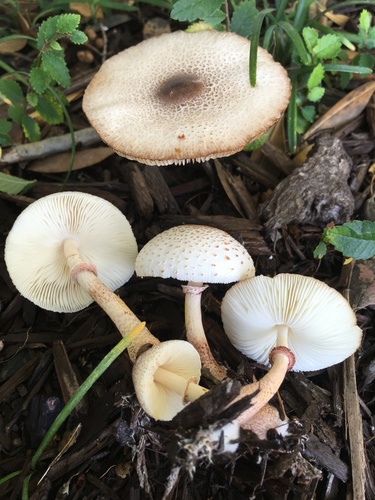
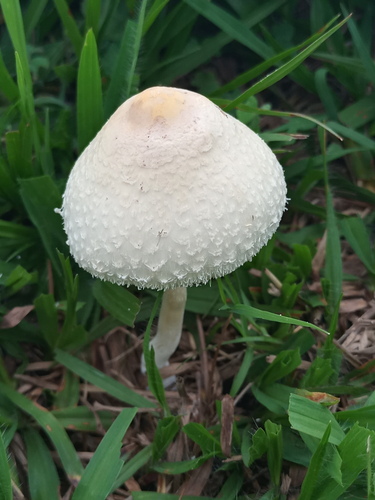
Chlorophyllum hortense (Murrill) Vellinga has the following morphological characteristics. When mature, its cap measures 8 to 10 cm wide. It starts convex and slightly umbonate before expanding to its full size. The cap surface is dry, dirty yellowish-white, and covered in thread-like fibrillose filaments. The central disc of the cap is light brown, covered in large, light brown, woolly floccose scales. The cap edges are thick and rounded, match the colour of the main cap surface, and have distinct striations. The stem is 5 to 7 cm long and 7 to 10 mm thick. It is mostly equal in thickness along its entire length, but is sometimes slightly wider below the stem ring. Above the stem ring, the stem surface is smooth and white; below the stem ring, it is usually brown and fibrillose. The interior of the stem is tough and solid. The stem ring itself is thick and brown, and located from inferior to the middle of the stem, that is, between the lower section and midpoint of the stem. The gills are free, crowded, white, and do not change colour. They have a slight bulge in the middle, making them ventricose. The spores are ellipsoid, smooth, and measure 8–9 × 6–7 μm. This fungus is found in Australia and North America. It was first reported from China in 2006. Murrill originally described this species from specimens collected on sandy soil in Alabama.