About Chlorogalum pomeridianum (DC.) Kunth
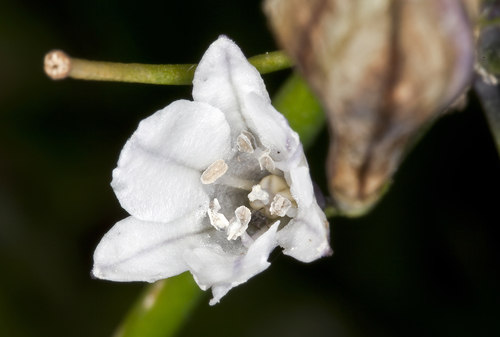
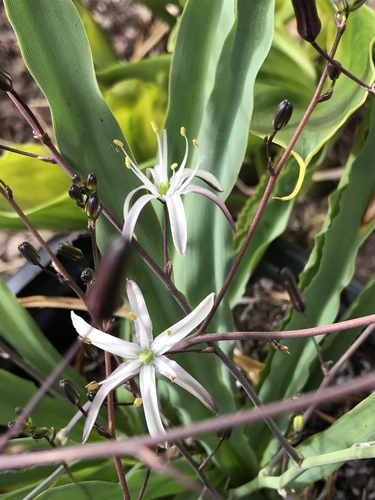
Like all soap plants, Chlorogalum pomeridianum is a perennial plant that grows from a bulb. The bulb is brown, between 7 and 15 cm in diameter, slightly elongated, and covered in thick, coarse fibers. Its leaves grow from the base of the plant, and can reach 20 to 70 cm long and 6 to 25 mm wide. As the plant's common name suggests, leaf edges are generally wavy, though this trait is not always particularly noticeable. Flowers grow on a long stem that is normally longer than the leaves, and the stem itself is 15 to 30 mm long. The plant has six outward-curving petal-like structures up to 35 mm long; technically, only three of these are true petals, while the other three are sepals. These structures are typically white but have a noticeable mid-vein that can be purple or green. The six large, noticeable stamens are yellow or orange. The flowers are hermaphroditic, meaning they have both male and female reproductive parts. They open only in the late afternoon or evening, remain open through the night, and close by the morning. They are pollinated by evening- or night-flying insects. The fibers surrounding the bulb were widely bound together to make small brushes. Bulb extracts could also be used as a sealant or glue. The bulb's juices contain saponins that form a lather when mixed with water. Both Native American groups such as the Miwok tribe and early European settlers used the bulbs as a type of soap, which is the origin of the plant's common name. It was especially used for washing hair, as it was considered effective against dandruff. The young leaves of Chlorogalum pomeridianum can be used as food, but the saponins in the bulbs make them poisonous. That said, saponins are very poorly absorbed by the human body and usually pass straight through, and they can be destroyed completely by thorough cooking. The Miwok people roasted and ate the bulbs as a winter food. In February 1847, Patrick Breen of the ill-fated Donner Party recorded that a Native American gave the starving settler some "roots resembling Onions in shape [that] taste some like a sweet potatoe [sic], all full of little tough fibres." Breen's son later identified the roots as "California soap-root," which is almost certainly C. pomeridianum. Saponins are much more toxic to some other animals than they are to humans. Fish are particularly susceptible, and bulb juices were used to kill or stun fish so they could be caught easily. The bulbs also had various medicinal uses, both external and internal. Externally, they were used to make poultices that worked as an antiseptic, and as a rub for cases of rheumatism. Internally, decoctions made from the bulbs were used for a range of purposes, including as a diuretic, as a laxative, and to treat stomachache.