About Chlorociboria aeruginosa (Oeder) Seaver
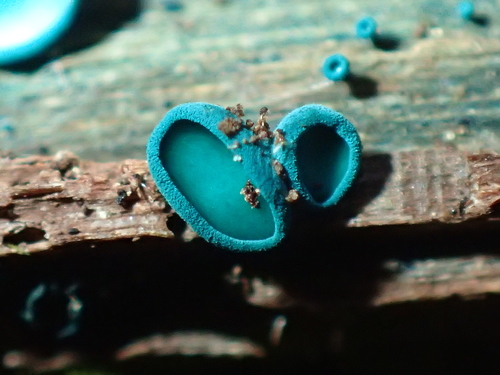
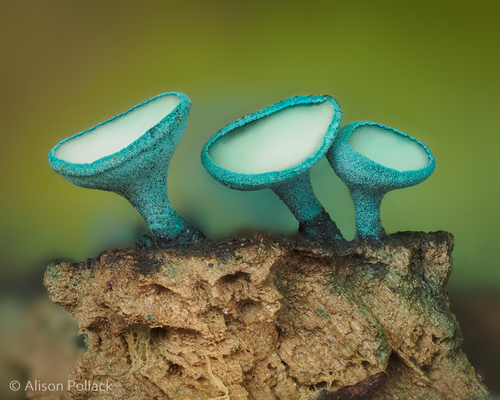
Chlorociboria aeruginosa produces cup-shaped ascocarps called apothecia, which are usually attached laterally. Most apothecia are less than 0.5 cm in diameter, but they can reach between 0.5 and 1 cm across. When the apothecia dry, they collapse laterally and roll inwards. The outer tissue layer of the apothecium is bright green and smooth on the upper surface; it is felty and pale blue-green on the underside and stipe, and darkens as the fungus ages. The stipe is typically short, and connects to the apothecium either centrally or eccentrically. The spores of this species are roughly fusiform (spindle-shaped), smooth, and measure 9-14 by 2-4 μm. It produces a white spore print. The asci hold eight spores each, and typically measure 65 by 5 μm. Apothecia of Chlorociboria aeruginosa grow on bark-free wood, especially that of oak, beech, and hazel. The mycelium of the fungus stains at least part of the colonized wood greenish. This species is closely related to Chlorociboria aeruginascens, and is distinguished from it by its larger spores. While some authors have historically not recognized any meaningful differences between the two species, Ramamurthi and colleagues report that the two differ not just in spore size: C. aeruginosa has roughened hyphae, whereas C. aeruginascens has smooth hyphae.