About Chlorociboria aeruginascens (Nyl.) Kanouse
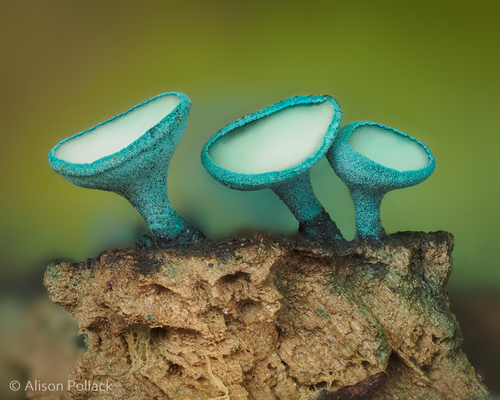
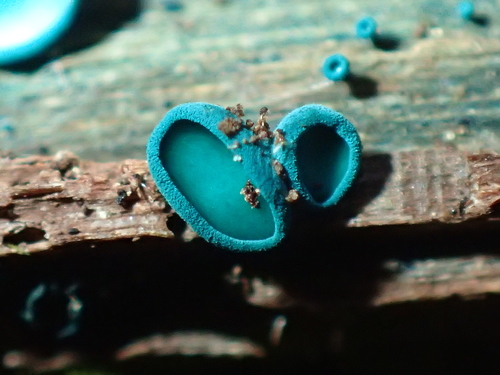
Chlorociboria aeruginascens produces cup-shaped fungal fruiting bodies called apothecia. These apothecia usually attach laterally, most often measure less than 0.5 centimeters (1/4 inch) across, collapse to the side, and roll inward when they dry out. The outer tissue layer of the apothecium, called the ectal excipulum, has a soft, hairy (tomentose) surface made up of hair-like, smooth hyphae that are straight, or sometimes coiled. The stipe (stalk) of the apothecium is usually less than 3 millimeters long, and attaches to the center or an off-center point of the apothecium. Its spores are roughly spindle-shaped (fusiform), smooth, and measure 5–8 by 0.7–2.8 micrometers. The spore print of this species is white. The apothecia grow on debarked wood, particularly oak wood; the mycelium of the fungus stains at least part of this wood greenish. Chlorociboria aeruginascens produces abundant paraphyses, which may be intertwined; these structures are 55–95 by 1.5–2 micrometers, thread-like (filiform), and segmented (septate), with unswollen, straight apices that often extend past the tips of the asci.