About Chloephaga picta (J.F.Gmelin, 1789)
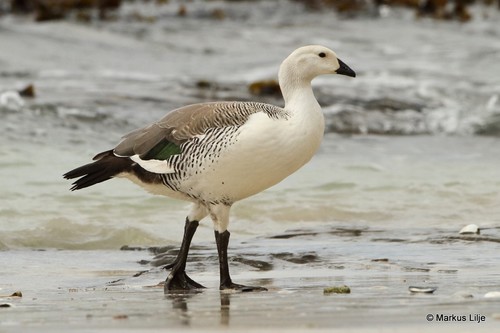
Chloephaga picta, commonly known as the upland goose, is a waterfowl species with strong sexual dimorphism in plumage. Males of this species are similar to other sheldgeese, especially the kelp goose (Chloephaga hybrida), due to their mostly white plumage, while females resemble the ruddy-headed goose (C. rubidiceps) due to their similarly barred breast plumage. The species has a total length ranging from 60 to 72.5 centimetres (23.6–28.5 in). The greater Magellan goose, the leucoptera subspecies, is the largest bird in the genus Chloephaga; males of this subspecies typically weigh 3.5–4.5 kg (7.7–9.9 lbs), and females weigh 2.9 to 3.5 kg (6.4–7.7 lbs). For the lesser Magellan goose, the nominate picta subspecies, males average 2.7–3.6 kg (6.0–7.9 lbs) and females average 2.9–3.5 kg (6.4–6.8 lbs). In terms of general plumage differences between sexes, males have white heads and breast plumage with black legs, while females have reddish-brown heads and breast plumage with yellow-orange legs. There are two interbreeding male morphs: one has black-barred breast plumage, and the other has white breast plumage. Adult males also have a greenish-bronze speculum on their inner secondary flight feathers. Vocalizations differ by sex too: males produce a whistling "wheep" call, while females make a low, rattling "a-rrr" sound. Upland geese molt both primary and secondary feathers in ponds or sheltered sea inlets, usually between late November and early January. Molting frequency depends partly on breeding success, because most molting adults have either not yet mated or failed to breed. Some greater Magellan geese skip this annual molt, retaining flight ability during the austral summer. While this behavior is unusual, it may provide energetic advantages, as the molting season is nutritionally very taxing. In Chapter VI of On the Origin of Species, Charles Darwin noted that the upland goose has toe webbing that appears "rudimentary in function, though not in structure", and concluded this was a vestigial anatomical feature for the species. Upland geese usually live in small, scattered groups across most pasture types, including temperate grasslands and arid lowland scrubs, and they favor areas with short green grasses. Recent land use changes shifting toward crop fields and managed pastures have forced the species to adapt to and colonize these modern landscapes. This goose is distributed across southern South America, including central and southern Chile, Argentina, and the Falkland Islands; its continental range extends from central Chile/southern Argentina down to Tierra del Fuego, near Antarctica. Lesser Magellan geese usually live in Patagonia or southern Chile, and migrate north to central Argentina for their wintering grounds each year. The southernmost populations are the most likely to migrate, and migrating individuals can reach flight speeds of over 40 km/h (25 mph). In 2013, researchers recorded a lesser Magellan goose in southern Brazil, which redefined the northern edge of the species' wintering range. In contrast, greater Magellan geese do not migrate and rarely leave the Falkland Islands. Overall, the highest population densities of upland geese occur around ponds and in green grasslands. Population range computer modelling shows that the species' distribution is favored by abundant green grasses for feeding and breeding, and hindered by human activity, particularly urbanization and oil extraction. There is also a sizeable introduced population of the species on sub-Antarctic South Georgia Island. The upland goose is primarily a herbivore, feeding mostly on seeds, leaves, stems, and other plant matter. The species is very gregarious, and flocks of thousands of individuals can be found grazing on a single pasture. Farmers consider upland geese pests because the geese graze on pastures used for cattle and sheep, and farmers claim the geese significantly reduce crop yields. However, a recent study found that while sheldgeese do reduce wheat cover, they do not reduce overall wheat yield, and may even provide an ecosystem service through grazing on weeds.