About Chliaria othona (Hewitson, 1865)
Scientific name: Chliaria othona (Hewitson, 1865), commonly known as the orchid tit.
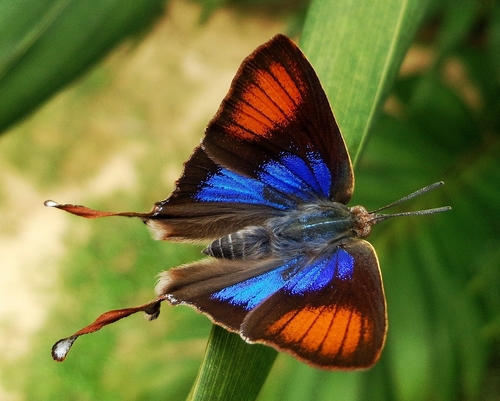
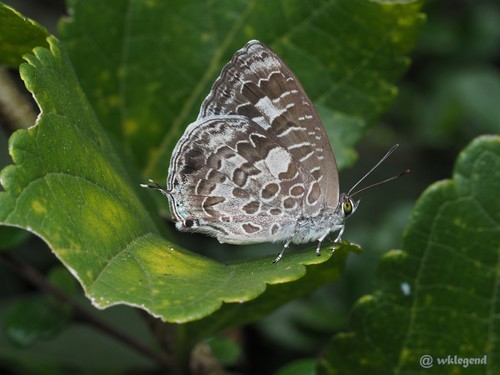
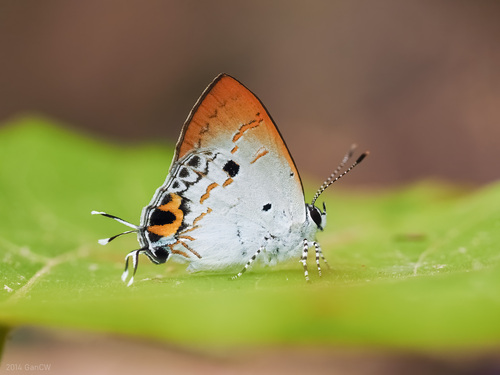
Description of the male: Upperside is dark blue. On the forewing, the apical half is black; its inner margin crosses the end of the cell to vein 2 near the outer wing margin, and continues from there to the hinder angle as a moderately broad band. The costal band, running from the upper end of the cell to the base, is somewhat narrower. Cilia are brown. On the hindwing, the costa and apex have a moderately broad black band, with the rest of the wing blue. There is a fine black outer marginal line with an inner white line, and the abdominal fold is whitish. Tails are black with white tips, and the outer margin is nearly evenly rounded. Cilia are white with grey tips. Underside is whitish-grey, with chocolate-brown markings. The forewing has a black sub-costal spot one-quarter of the way from the base, a double line crossing the end of the cell, and a rather broad shorthand shape from near the costa to vein 4 made of two conjoined squarish spots, with the lower spot being larger. The band continues hindward as a narrow straight streak that ends in a point on the sub-median vein. There is also a sub-marginal lunular line and a dark band close to the margin. The hindwing has a sub-basal spot below the costa, two close pale lines closing the cell matching those on the forewing, and an irregular discal band. The discal band starts on the costa with two conjoined, inwardly oblique dark spots, plus two more similar spots whose upper inner end touches the lower outer end of the first two spots. It then has two more conjoined but smaller spots placed inward, with their upper outer end well separated from the lower inner end of the two spots above. There is a sub-marginal lunular line, whose lower portion is well separated from the outer wing margin, a sub-terminal series of small, pale brown lunular spots, a small black anal spot, and a larger black spot in the first interspace. The small anal spot is capped with orange, with a short pale orange streak running up the abdominal margin; the larger spot has its upper portion rather broadly ringed with orange. Both wings have a terminal black line. Cilia are white, with brown spots opposite the vein ends. Antennae are black, ringed with white; head and body are blackish-brown above, and grey beneath.
Description of the female: Upperside is dark brownish-grey. Forewing marginal bands match those of the male, but are less dark. Hindwing ground colour is darker at the base, and gradually pales toward the outer margin; in some individuals, the lower third of the wing is quite pale, almost grey. There is a black terminal line with an inner white thread. Cilia are grey. Underside matches that of the male.
Distribution: The orchid tit is found in Bangladesh, India, Myanmar, Thailand, Laos, northern Vietnam, Peninsular Malaysia, and Pulau Tioman, and possibly also in Taiwan. Within India, the butterfly occurs in the Western Ghats, and the Himalayas from Garhwal to Assam, through Bengal and onward to Myanmar. In Sikkim, it can be found up to an altitude of 5,000 feet (1,500 m).
Life cycle: The caterpillar (larva) is green and onisciform (woodlouse-shaped), with a red dorsal band and three red rippled lines on each side. The caterpillar's head is concealed, its body is covered in minute bristles, and distinct short protuberances extend from the anal segment. It feeds on orchid flowers. The pupa is smooth and greenish grey, and resembles pupae of other Lycaenidae species. It has a few white markings, with a distinctly wavy pattern on the wing covers. It is found fastened to the stem of orchids.
Larval food plants: The larval host plants of the orchid tit belong to the family Orchidaceae, in the genera Arundina, Dendrobium, Papilionanthe, Phaius, Phalaenopsis, and Spathoglottis. Recorded host species are Papilionanthe subulata and Spathoglottis plicata.