About Chironius flavolineatus Jan, 1863
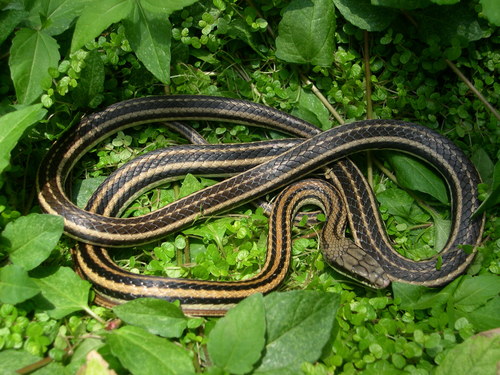
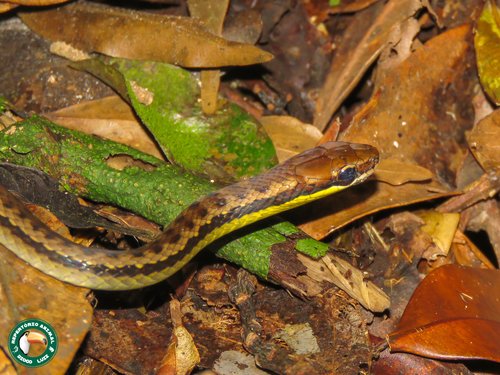
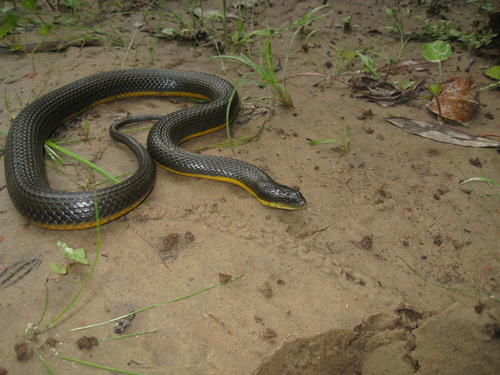
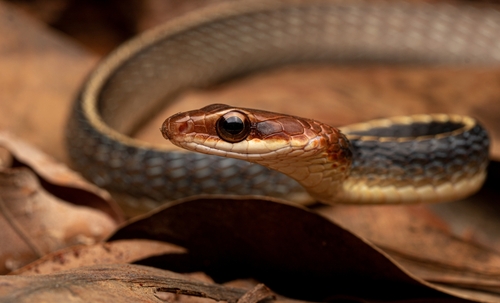
The most distinguishing trait of Chironius flavolineatus is a yellow or creamy-white vertebral stripe that runs along almost the entire length of its body. On either side of this stripe, black lateral markings are located anteriorly, starting just after the first row of scales. The dorsal surface of this snake’s head ranges in color from tan to brown, and is distinctly colored compared to the upper third of the body, which is black or dark gray. Chironius flavolineatus usually has a single posterior temporalis muscle, a divided cloacal shield, and white, unpigmented ventral and subcaudal scales. It also has 0 to 4 rows of keeled dorsal scales at midbody, and keeps the same static color pattern throughout its life. Studies show that Chironius flavolineatus is sexually dimorphic. Adult females are typically larger than adult males: females have an average weight of around 81 g (2.9 oz) and an average total length of about 1.16 m (3 ft 10 in), while males have an average weight of around 60 g (2.1 oz) and an average total length of around 1.10 m (3 ft 7 in). Males also tend to have longer tails and larger eyes than females, while no sexual dimorphism in head size has been observed. The smaller average size of males is thought to indicate limited male-to-male combat for mates. Differences in eye diameter, which have also been observed in other Chironius genus members native to Atlantic Forests, are often linked to male-exclusive activities such as searching for female mates. Female Chironius flavolineatus only begin reproducing once their body reaches a size large enough to carry eggs, creating selective pressure that results in females of the species being larger than males on average. This snake’s thin body and long tail suggest it has arboreal tendencies when living in savanna environments. This speculation is supported by field observations, which show Chironius flavolineatus forages on the ground before resting at night in above-ground vegetation. No specific type locality has been designated for Chironius flavolineatus. It has been recorded in São Paulo, Amazonas, Rio Grande do Sul, Pernambuco, Rio Grande do Norte and many other regions across South America. It occurs predominantly in Brazil, but can also be found in Paraguay, Bolivia and Peru. It is most commonly found at elevations between 100 and 400 meters above sea level, in biomes including semiarboreal forests and grass steppes. Chironius flavolineatus has multiple defense mechanisms to avoid harm from predators, and makes use of camouflage. Its primary defensive behaviors are cryptic coloration, camouflage, and mimicry. For example, this snake will hide in a pile of decaying leaf litter where it cannot be detected until a threat or predator has passed. It has been observed resting in this decaying leaf litter roughly 2 meters above ground during nighttime, confirming its preference for arboreal resting sites — this contrasts with its active ground-foraging behavior during the day. A rare additional escape tactic used by this species is diving. While many semi-aquatic snake species regularly use water as a defense, C. flavolineatus is normally an arboreal species. However, it has been recorded diving into water to escape when foraging near a river. Male Chironius flavolineatus reach sexual maturity when they have enlarged testes and opaque deferens ductus, where sperm is stored. Females reach maturity when they develop either ovarian follicles, oviduct eggs, or both. Females have a seasonal reproductive cycle: vitellogenic follicles and oviduct eggs are most abundant for fertilization during the rainy season. Clutches laid by C. flavolineatus contain around 21 eggs, with eggs having an average diameter of 34.4 ± 6.4mm, ranging from 25.1–51.3 mm (0.99–2.02 in). Males, by contrast, have continuous sperm production in the testes and continuous sperm storage in the deferens ductus. The documented larger size of C. flavolineatus females is also driven by a strong male preference for females with a larger snout-vent length. Courtship behavior has been recorded in October during the rainy season, and data indicates that mating in this species occurs in at least two separate periods each year. As an oviparous species, C. flavolineatus develops eggs inside the female’s body before laying the entire clutch, averaging 21 eggs, all at once. Eggs must be incubated at appropriate temperatures between 19 to 32 °C (66 to 90 °F) with the correct humidity for embryonic development before hatching. After hatching, young snakes (called hatchlings or neonates) continue to grow until they reach sexual maturity.