About Chionophila tweedyi (Canby & Rose) Hend.
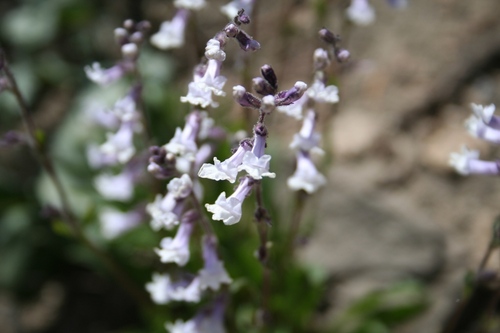
Chionophila tweedyi (Canby & Rose) Hend. is a perennial herb that grows up to 30 cm (12 inches) tall. The lower portions of the plant are glabrous, meaning they have no hairs, while the upper portions are covered in glandular hairs. Most of its leaves are basal, slender with a wider shape toward the tip, and can reach 9 cm (3.5 inches) in length. There are very few stem leaves, which occur in just 1 or 2 pairs and are much smaller than the basal leaves. The inflorescence holds 4 to 10 flowers arranged in a one-sided raceme, and each flower is subtended by a pair of bracts. The corolla is white and lavender, tubular, two-lipped, and can reach up to 13 mm (0.51 inches) long. Chionophila tweedyi is one of only two species in the Chionophila genus. The other species, C. jamesii, is endemic to south central Wyoming, Colorado, and northern New Mexico, and has a dense, spikelike inflorescence with overlapping flowers. In contrast, the flowers of C. tweedyi are widely spaced, so the rachis, or central flower stem, is clearly visible. Chionophila tweedyi is endemic to the northern Rocky Mountains in central Idaho and southwestern Montana. It has been collected from talus and wet meadows near the timber line. This species' affinity for high-elevation habitats is reflected in both its common name "Tweedy's snowlover" and its generic name: the name comes from the Greek words chion meaning snow, and philios meaning loving.