About Chimaphila umbellata (L.) W.P.C.Barton
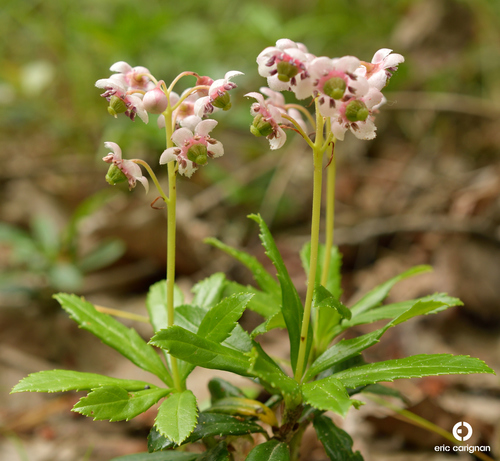
Chimaphila umbellata (L.) W.P.C.Barton is a flowering plant that reaches a maximum height of 35 cm (12 inches). It grows a single simple stem, along which evergreen, shiny leaves with toothed edges are arranged in opposite pairs, whorls of 3 to 5, or sometimes larger whorls. Its leaves have a slightly spiny finely serrated margin starting near the base, are typically oblanceolate in shape, and range from 1 ½ to 2 ½ inches long, occasionally growing longer. Its flowers are white to pink, and grow in small umbels containing 4 to 8 flowers each. The stamens' filaments have a roundish expansion at the base, and only the margin of this expansion bears hairs; this distinguishes the species from its close relative C. menziesii, which also has hairs on the back of the filament expansion. Though Chimaphila umbellata has green leaves year-round, it gets a large portion of its nutrients from soil fungi, making it a partial myco-heterotroph. This trait is not unexpected, as related genera such as Pyrola also include partial or full myco-heterotrophs. Some Plateau Indian tribes used a boiled preparation of prince's pine, the common name for this plant, to treat tuberculosis. Twentieth-century Appalachian folk healer Clarence "Catfish" Gray, known as the "Man of the Woods", claimed pipsissewa (another common name for this species) cured his own heart problems, and included the plant in his 15-herb cure-all bitters. It is reported to be used as a flavoring for candy and soft drinks, especially root beer. Boiled roots and leaves of Chimaphila umbellata can be made into tea. Recent research has found that Chimaphila umbellata has an anti-proliferative effect on human MCF-7 breast cancer cells.