About Chiloglottis valida D.L.Jones
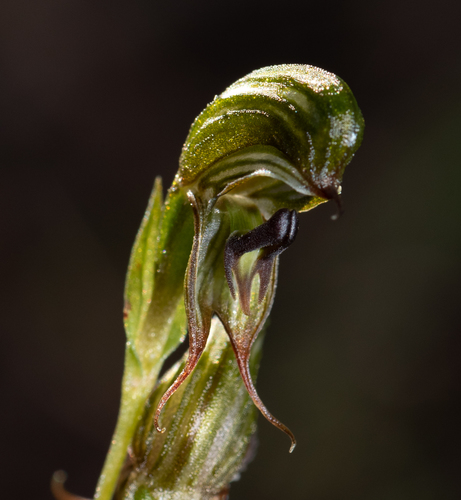
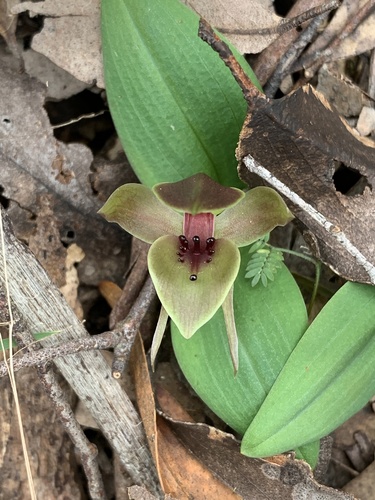
Chiloglottis valida is a terrestrial, perennial, deciduous herb. It produces two dark green, broadly elliptic leaves that are 50–100 mm (2–4 in) long and 20–40 mm (0.8–2 in) wide. A single greenish purple to purplish brown flower, 20–30 mm (0.8–1 in) long and 30–35 mm (1.2–1.4 in) wide, grows on a 40–70 mm (2–3 in) tall flowering stem.
The dorsal sepal is spatula-shaped to egg-shaped, with the narrower end at the base. It measures 19–30 mm (0.7–1 in) long and 4–7 mm (0.2–0.3 in) wide, and ends in a glandular tip around 1–2.5 mm (0.04–0.1 in) long. The lateral sepals are linear, taper towards the tip, and are 17–25 mm (0.7–1 in) long and 3–4 mm (0.1–0.2 in) wide; they curve downwards and apart from each other, and each has a glandular tip around 1 mm (0.04 in) long.
The petals are egg-shaped to lance-shaped, 17–23 mm (0.7–0.9 in) long and 8–11 mm (0.3–0.4 in) wide. They are spaced apart from each other and curve upwards and inwards towards the labellum. The labellum is broadly heart-shaped, 14–18.5 mm (0.6–0.7 in) long and 12–16 mm (0.5–0.6 in) wide. It bears a large, black, column-like callus up to 4 mm (0.2 in) long, which is surrounded by between one and four pairs of smaller calli.
The column is greenish brown with darker markings, 13–17 mm (0.5–0.7 in) long and around 8 mm (0.3 in) wide, with broad wings. Flowering occurs between October and February.
Commonly called the large bird orchid, this species is widespread and common, growing in a range of habitats from coastal to subalpine areas. It is most abundant in Victoria, where it grows across the entire state except the far west. In New South Wales and the Australian Capital Territory, it occurs south of the Brindabella Range, and it also grows on King Island in Tasmania.