About Chiloglottis trapeziformis Fitzg.
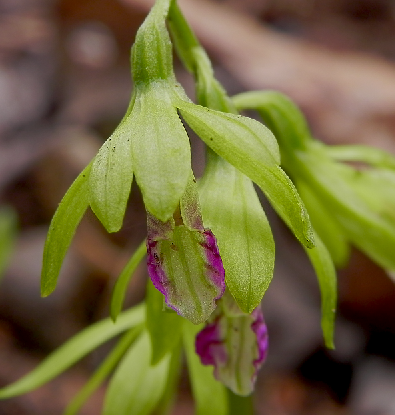
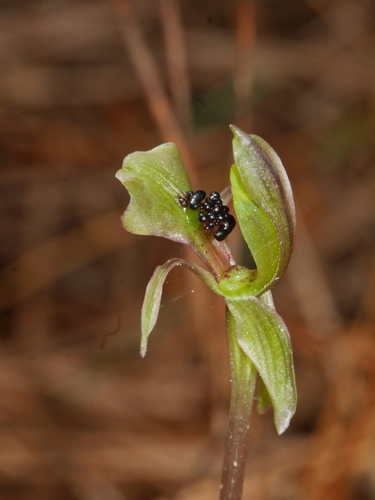
Chiloglottis trapeziformis Fitzg. is a terrestrial, perennial, deciduous herb that grows two leaves, each 30 to 80 mm (1 to 3 in) long and 10 to 25 mm (0.4 to 1 in) wide. It produces a single greenish to purplish or brownish flower, 12 to 16 mm (0.5 to 0.6 in) long and 6 to 8 mm (0.2 to 0.3 in) wide, borne on a flowering stem that stands 80 to 140 mm (3 to 6 in) high. The dorsal sepal is spatula-shaped, 11 to 13 mm (0.4 to 0.5 in) long and about 3 mm (0.1 in) wide. The lateral sepals are linear, 9 to 12 mm (0.35 to 0.47 in) long and 1 to 2.5 mm (0.04 to 0.1 in) wide, curving downwards and away from each other. All three sepals have a glandular tip about 0.5 mm (0.02 in) long at their end. The petals are oblong or broadly linear, 8 to 15 mm (0.3 to 0.6 in) long and 3 to 4 mm (0.1 to 0.2 in) wide, and turn downwards near the ovary. The labellum is erect and diamond-shaped, 7 to 12 mm (0.3 to 0.5 in) long and 6 to 8 mm (0.2 to 0.3 in) wide. It has a narrow, shiny black, ant-like callus that covers one quarter of its upper surface. Flowering takes place from August to November. This species, commonly called broad-lip bird orchid, is widespread and common in sheltered sites across a wide range of habitats. It occurs in south-eastern Queensland, eastern New South Wales, and eastern Victoria. There is one small single population in south-eastern South Australia, and scattered populations at Wynyard, Launceston, Flinders Island, and Great Dog Island in Tasmania. A single vagrant population, which is now extinct, was previously recorded from a pine plantation near Levin in New Zealand.