About Chiloglottis seminuda D.L.Jones
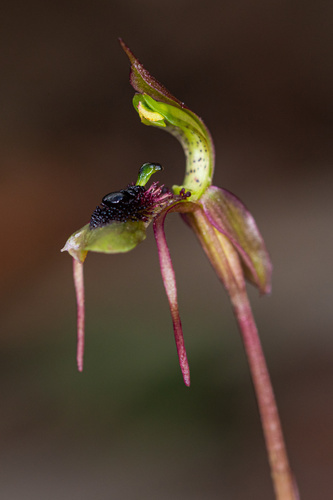
Chiloglottis seminuda, commonly known as the turtle orchid, is a terrestrial, perennial, deciduous herb. It produces two elliptic to oblong leaves, each 25 to 85 mm long and 10 to 18 mm wide, borne on a petiole 5 to 20 mm long. A single green to reddish pink flower, 10 to 14 mm long, grows on a flowering stem that stands 100 to 150 mm high.
The erect dorsal sepal is narrow spatula-shaped, measuring 10 to 15 mm long and 2.5 to 3 mm wide, and ends in a glandular tip 2 to 2.5 mm long. The lateral sepals are linear, 13 to 18 mm long and approximately 1 mm wide, curve downwards and spread apart from each other, and each has a glandular tip 3 to 7 mm long. The petals are narrow oblong, 8 to 11 mm long and 2 to 3 mm wide, and curve downwards toward the ovary.
The labellum is diamond-shaped, 8 to 10 mm long and 5 to 6.5 mm wide. A shiny black, insect-like callus 1.8 mm long covers two-thirds of the labellum's base. This large callus is surrounded by pinkish, club-shaped calli, while shorter black calli are located closer to the labellum's tip. The outermost one-third of the labellum has no calli. The column is pale green with dark purple spots and flecks, 6.5 to 7.5 mm long and approximately 2 mm wide, with narrow wings. Flowering takes place from January to April.
This orchid grows in moist forest. Its main range extends between the Blue Mountains and Clyde Mountain in New South Wales, with several isolated records of the species from Victoria.