About Chiloglottis reflexa (Labill.) Druce
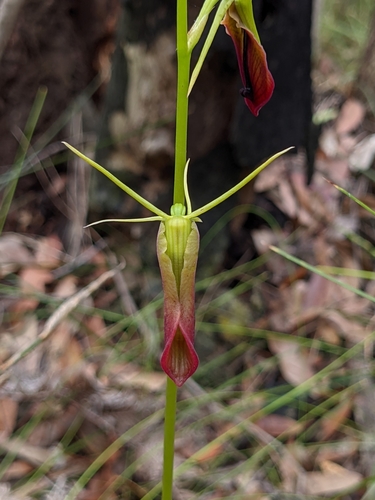
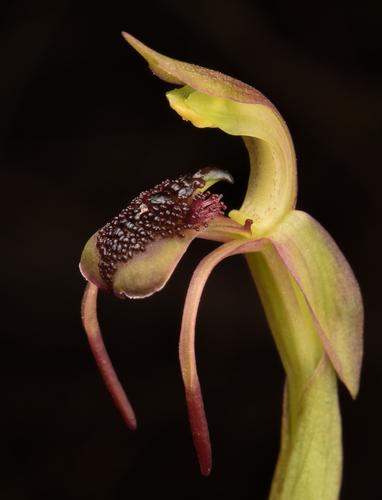
Chiloglottis reflexa is a terrestrial, perennial, deciduous herb. It has two egg-shaped to elliptic leaves that measure 20–60 mm (0.8–2 in) long and 10–30 mm (0.4–1 in) wide. A single greenish-bronze or purplish flower, 22–28 mm (0.9–1 in) long and 10–12 mm (0.4–0.5 in) wide, is borne on a flowering stem that grows 60–100 mm (2–4 in) high. The dorsal sepal is spatula-shaped, 10–15 mm (0.4–0.6 in) long and 2–3.5 mm (0.08–0.1 in) wide. The lateral sepals are linear, 10–13 mm (0.4–0.5 in) long, less than 1 mm (0.04 in) wide, and curve downwards. A glandular tip sits at the end of each sepal: the tip on the dorsal sepal is 1–2.5 mm (0.04–0.1 in) long, and the tip on lateral sepals is 1.5–3.5 mm (0.06–0.1 in) long. The petals are oblong, 8–11 mm (0.3–0.4 in) long, about 2.5 mm (0.1 in) wide, and turned downwards near the ovary. The labellum is held horizontally, is diamond-shaped, and measures 8–11 mm (0.31–0.43 in) long and 5–7 mm (0.2–0.3 in) wide. A callus that resembles a large black ant, surrounded by thin, stalked glands, covers most of the labellum. The column has narrow wings. Flowering occurs from December to May. This species, commonly called the short-clubbed wasp orchid, grows in a wide range of habitats, and is most common in coastal and near-coastal forest and heath. It occurs in New South Wales south from the Blue Mountains, in southern Victoria, and in Tasmania.