About Chiloglottis jeanesii D.L.Jones
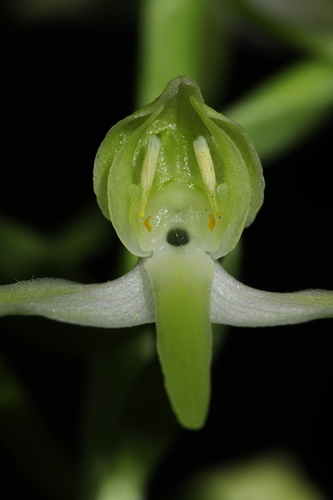
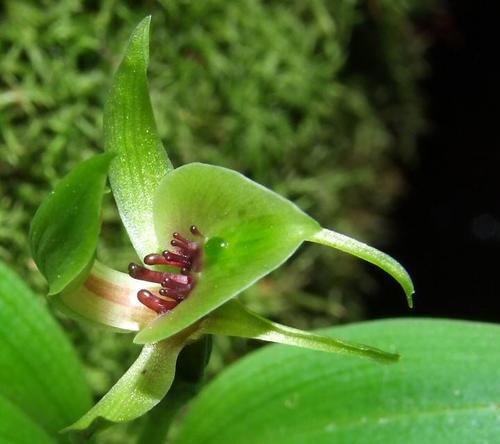
Chiloglottis jeanesii is a terrestrial, perennial, deciduous herb. It produces two elliptic leaves, each 27–40 mm (1–2 in) long and 10–18 mm (0.4–0.7 in) wide, borne on a petiole 8–18 mm (0.3–0.7 in) long. A single flower is carried on a flowering stem 45–70 mm (2–3 in) high. The flower ranges from green to dark purplish brown, and measures 17–20 mm (0.7–0.8 in) long and 25–30 mm (0.98–1.2 in) wide.
The dorsal sepal is egg-shaped, with the narrower end oriented toward the base. It is 17–20 mm (0.7–0.8 in) long and 7–9 mm (0.3–0.4 in) wide. The lateral sepals are narrow and linear, 14–17 mm (0.6–0.7 in) long and about 2 mm (0.08 in) wide. They are held horizontally below the labellum, running more or less parallel to each other. All three sepals have a glandular tip around 1 mm (0.04 in) long.
The petals are narrow lance-shaped, curved, 13–16 mm (0.5–0.6 in) long and about 2.5 mm (0.1 in) wide. They spread widely apart from each other and curve upwards. The labellum is egg-shaped to heart-shaped, 10–13 mm (0.4–0.5 in) long and 9–12 mm (0.4–0.5 in) wide. Approximately half of the labellum’s upper surface is covered by a callus made of shiny black, column-like glands that reach up to 2.5 mm (0.1 in) long. The column is green to brown with reddish flecks, 12–15 mm (0.5–0.6 in) long and 5–6 mm (0.20–0.24 in) wide, with broad wings. Flowering occurs between November and January.
This species is commonly called the mountain bird orchid. It grows in moist to wet forest in mountainous areas, and is found in Sherbrooke Forest, Baw Baw National Park and Dandenong Ranges National Park.