About Chilocorus cacti Linnaeus, 1767
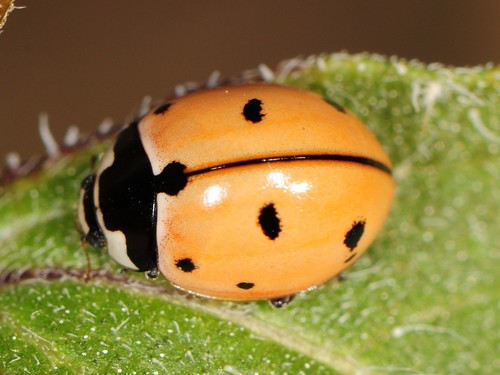
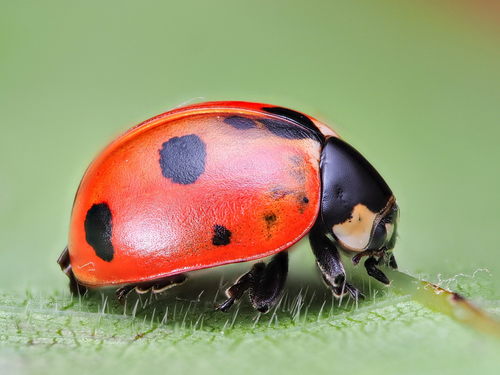
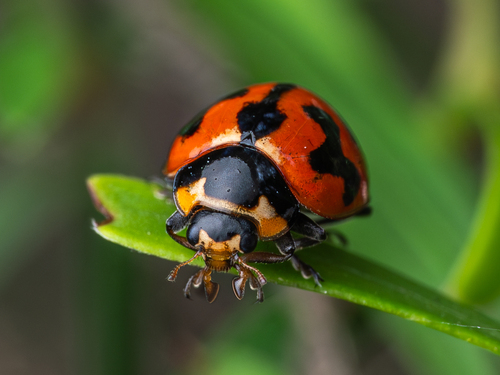
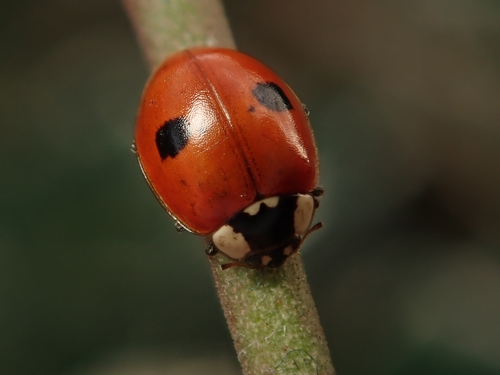
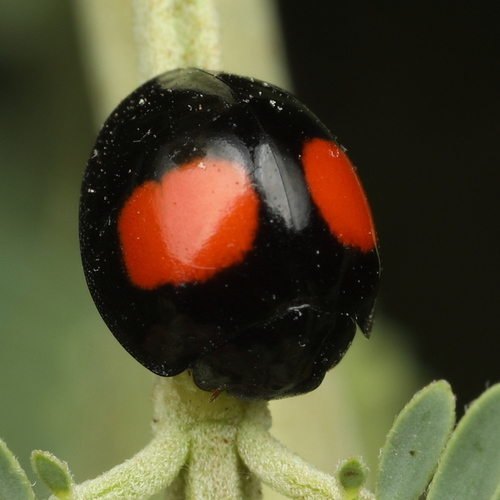
The eggs of Chilocorus cacti are approximately 1 mm (0.04 in) long, oval-shaped, and grey in color. The larvae are cylindrical and molt three times; the fourth instar larva reaches about 6 mm (0.24 in) in length. Larvae are black with a yellowish-brown girdle, and have large black spines along their dorsal surface. Pupae are diamond-shaped, roughly 5 mm (0.20 in) long, mottled black and brown, and are also covered in spines. Adult beetles are domed, growing up to 6 mm (0.24 in) long. They have a glossy black body with two large reddish-brown spots on the elytra. This lady beetle is similar in appearance to Chilocorus stigma, but can be distinguished by its ventral surface, which is burnt orange instead of black like C. stigma's ventral surface.
Chilocorus cacti is native to the New World, where its native range covers the southern United States, Mexico, Colombia, Peru, and the Caribbean region. It has since become established in South Africa, Eswatini, Morocco, São Tomé and Príncipe, India, and New Zealand. This lady beetle is most often found on prickly pear cacti (Opuntia), and on a variety of trees, especially coconut palms.
Both adult and larval Chilocorus cacti are predatory, and feed on scale insects. The scale insect species they consume varies by location, and includes Aonidiella aurantii, Aspidiotus destructor, Carulaspis minima, Coccus viridis, Melanaspis glomerata, Parlatoria blanchardi, Pseudaulacaspis pentagona, Selenaspidus articulatus, Hemiberlesia lataniae and Aulacaspis yasumatsui, many of which are major pests of citrus and other agricultural crops. In addition to scale insects, it preys on other pests including the citrus psyllid Diaphorina citri. Females lay eggs close to suitable prey populations, and eggs hatch after approximately ten days. Larvae feed for around 17 days before pupating, and adult beetles emerge roughly 13 days after pupation. In the United States, this species has no recorded natural enemies, possibly because birds and lizards avoid it due to its offensive odor. Its distinctive black and red coloration acts as a warning to potential predators that it is distasteful. Chilocorus cacti has been used for biological pest control in multiple countries, with mixed levels of success.