About Chilo suppressalis Walker, 1863
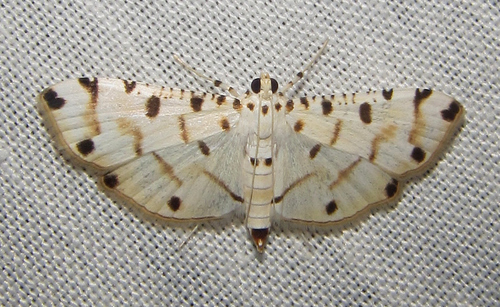
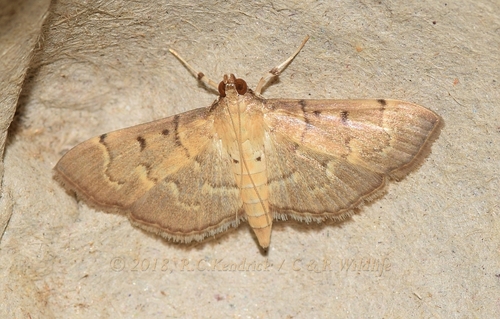
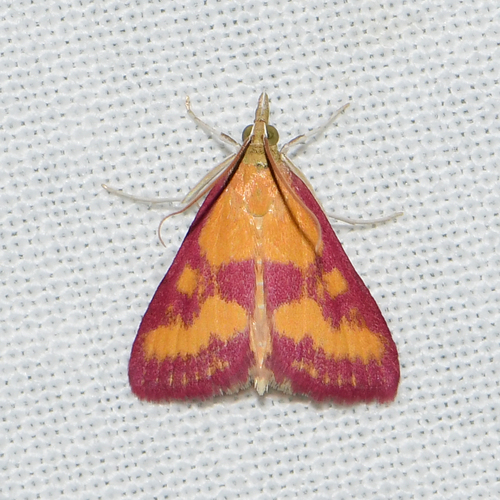
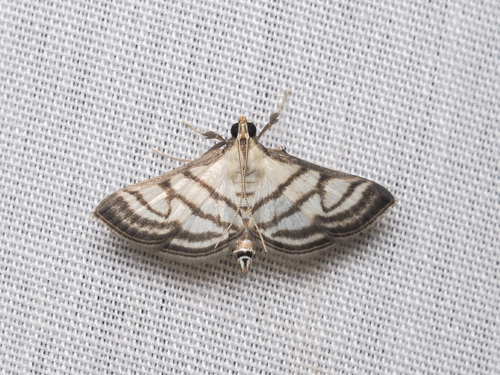
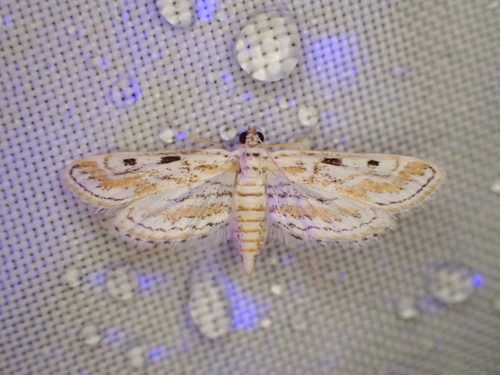
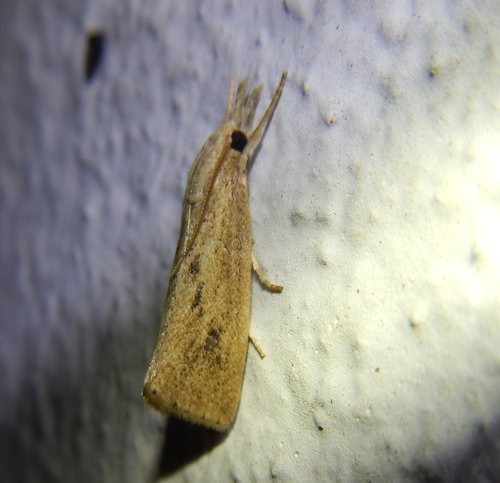
Chilo suppressalis Walker, 1863 has a wingspan of 18 mm in males and 18–20 mm in females. For males, the head and thorax are brown and white, and the abdomen is pale. Male forewings have a somewhat acute apex, are ochreous, and are entirely suffused with brown except for a patch in the cell and a streak below the medial nervure. The inner margin of male forewings is whitish. A sinuous rufous medial line runs across the forewing, with silvery spots on its inner side, on the discocellulars, and below vein 2. A rufous submarginal line is present, strongly angled at vein 6, with a silvery line on its outer edge. A marginal series of black specks is found, and the cilia are rufous. Male hindwings are whitish. Females are much more orange-fulvous in color. Female forewings are sprinkled (irrorated) with brown, and the medial and submarginal lines are almost obsolete. The silvery spots below the cell are prominent and sometimes double. The postmedial area is sprinkled with silvery scales. Eggs are scale-like, and range in color from translucent white to dark yellow. They are laid in naked clusters of nearly 60 overlapping rows. First-instar larvae are greyish white with a black head; the head capsule gradually turns brown as larvae develop toward their final instar. Full-grown larvae are yellow. Besides rice, which is the major food plant, larvae also feed on a wide range of other plants: Gigantochloa verticellata, Echinochloa crusgalli cruspavonis, Echinochloa stagnina, Eleusine indica, Panicum sp., Paspalum conjugatum, Amaranthus sp., Phragmites australis, Raphanus raphanistrum, Sclerostachya fusca, Sorghum sp., Typha latifolia, Xanthium strumarium, and Zizania aquatica. Pupation occurs inside the stem of the host food plant. Pupae are reddish brown, with two ribbed crests on the pronotal margins. The cremaster on the last abdominal segment has several spines. There are two distinct host-associated populations of this rice stem borer: one associated with rice, and the other associated with water oats (Zizania latifolia). Biological differences between these populations, including differences in mating timing, have led to suggestions that they may represent cryptic species. However, genetic analyses have found that gene flow occurs between these two host-associated populations.