About Chilades laius (Cramer, 1782)
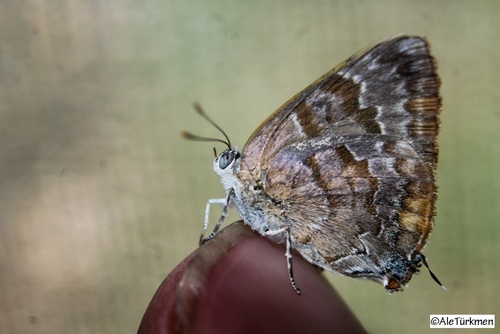
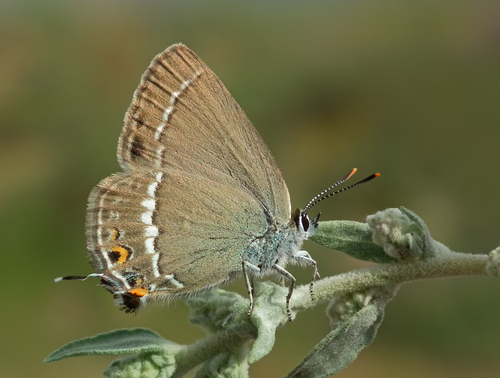
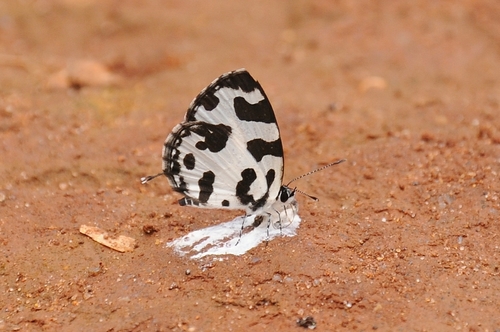
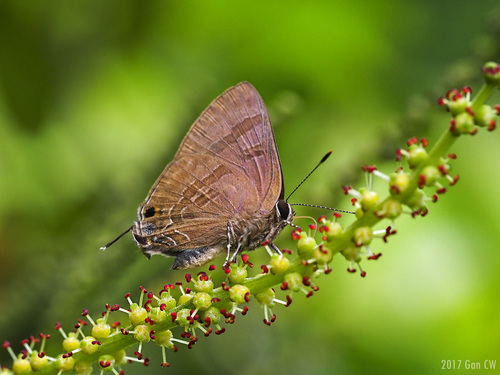
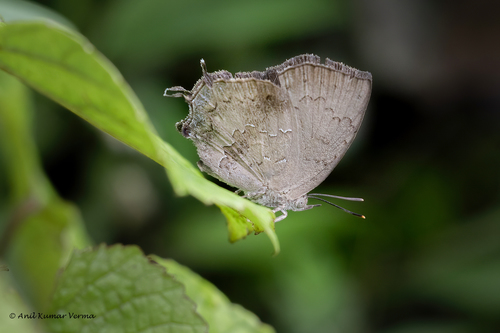
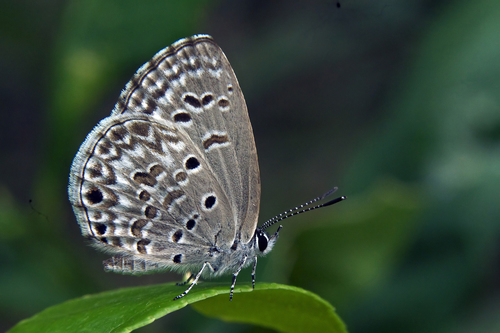
The species Chilades laius (Cramer, 1782) has distinct wet-season, dry-season, male, and female forms, detailed below. Wet-season form: Males have bluish-purple upperside wings. On the male forewing, the base and basal half of the costa are flushed pale blue; the costa and termen are edged with a slender, even dark brownish-black line. Beyond this line along the termen, cilia are brown at the base and white outwardly. On the male hindwing, the costa is somewhat broadly dusky black, with a slender, conspicuous black anteciliary line; beyond this line, cilia are white and crossed medially by a brown line. The dorsum is broadly pale brown, with two subterminal black spots with pale borders in interspace 1, and one similar spot in interspace 2 that is often obsolescent and barely visible. The underside of male wet-season wings is grey. On the forewing, a broad transverse lunule on the discocellulars and a transverse discal series of six dark brown spots are present; both the lunule and each discal spot are edged with white. The posterior four spots of the discal series are elongated and each placed obliquely, while the anterior two are round and curved inwards. A subterminal series of transverse elongated spots and an inner series of dusky brown lunules are also present, and both series are edged with white on the inner and outer sides. Finally, the forewing has a slender anteciliary black line. Cilia are white, crossed medially by a dark brown line. On the male hindwing, the following jet-black spots are thinly surrounded by white: a transverse subbasal series of four spots, and a subcostal spot in the middle of interspace 7 that is somewhat larger than the others. Below this larger spot, a catenulated (chain-linked) line of dusky-brown spots thinly edged with white (including the lunular spot on the discocellulars) crosses the wing. Beyond these marks, opposite the apex of the cell, are three similar discal spots, with the middle spot elongated. The terminal markings are made up of an inner continuous subterminal series of dusky lunules bordered with white on the inner and outer sides, an outer subterminal series of inwardly conical dusky-brown spots, and a slender anteciliary black line. The posterior two spots of the outer subterminal marking line are also black. Hindwing cilia are white. Male antennae are black, with shafts faintly ringed with white. The head, thorax, and abdomen are brown; the head, thorax, and base of the abdomen bear a small amount of blue scaling. On the underside, the palpi, thorax, and abdomen are white. Female wet-season forms have dark brown upperside wings. To a varying extent extending outwards from their bases, both forewings and hindwings are shot through with bright iridescent blue; this blue color does not reach the costa, termen, or dorsum of either wing. In addition to this base color, the female hindwing has a curved postdiscal series of whitish lunules that is very often obsolescent, and entirely absent in some specimens. This is followed by a subterminal series of black spots narrowly encircled with white, which are often obscure and do not reach the apex in some specimens. The anteciliary black lines and cilia match those of the male. The female underside is precisely identical to that of the male. Antennae, head, thorax, and abdomen also match the male. Dry-season form: Individuals closely resemble wet-season brood specimens, but can always be distinguished by the somewhat paler ground color of the upperside. On the underside, both sexes have a large nebulous brown patch on the posterior portion of the hindwing. Sometimes the underside ground color is much paler, nearly white, particularly in females.