About Chiasmia eleonora (Cramer)
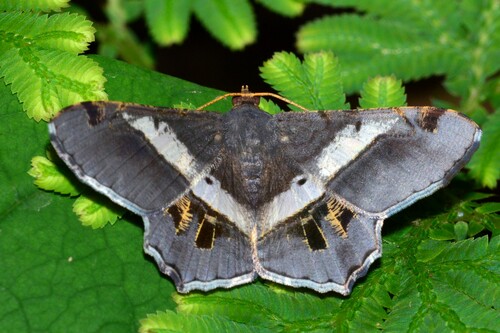
Chiasmia eleonora (Cramer) has a wingspan of approximately 42 mm. Its forewings have a slightly angled outer margin at vein 4. In males, the hind tibia is dilated, and the body is a slaty greyish color. The palpi, antennae, and abdomen are orange, except for the abdominal dorsum. The forewings bear an indistinct, curved, waved antemedial line. A broad white medial band does not reach the costa; beyond this band, a line bends outwards below the costa and nearly meets a fuscous orange-speckled blotch extending from the costa. The cilia are whitish, and are fuscous below the apex. The hindwings have a broad medial white band that encloses a speck at the end of the cell, with a dark line along its outer edge. Beyond this dark line sit two orange blotches irrorated with black; the lower blotch, and often the upper blotch as well, has a black patch at its center. The hindwing cilia are white. The ventral side of the moth has an orange wing base. Females are more heavily irrorated with fuscous than males, and are often suffused with rufous; their pale bands are grey, their cilia are fuscous, and the ventral side has an orange outer area with white blotches. The larva is either greenish with dorsal and sublateral yellow stripes, or brown with white stripes. Paired brush organs that produce pheromones are located at the ventral junction of the femur and tibia of the hindleg. The larva is a documented pest that attacks Mimosa rubicaulis and Acacia concinna.