About Cherleria obtusiloba (Rydb.) A.J.Moore & Dillenb.
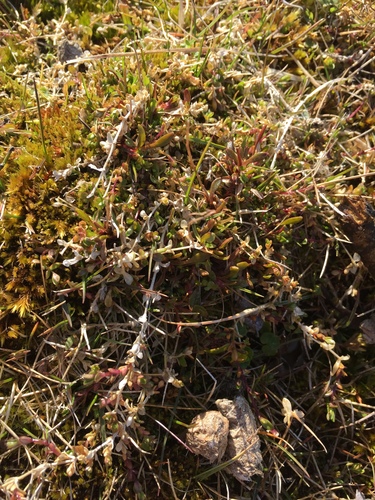
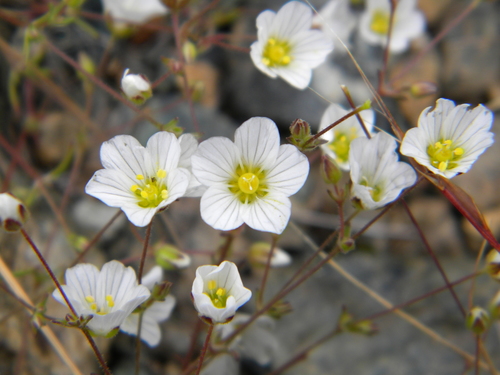
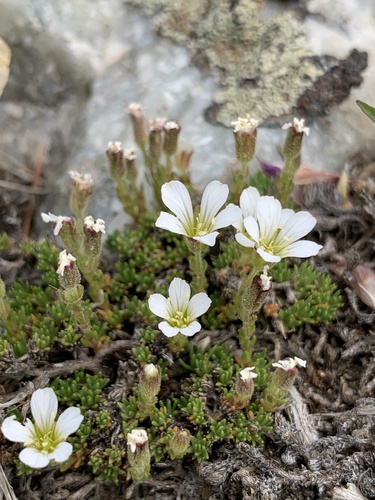
Scientific name: Cherleria obtusiloba (Rydb.) A.J.Moore & Dillenb., also known as alpine sandwort. Description: This is a perennial low-growing plant that forms tufts or mats. It reaches a maximum height of only 12 centimeters (4.7 inches), and most individuals grow just 1 to 5 cm tall, hugging the ground. It has a thick, woody taproot, and its mats can grow up to 40 cm (16 inches) across. Flowerless stems grow along the ground, ranging from as short as 2 cm to over 20 cm long, and branch. Flowering stems grow upward, though their bases sometimes rest on the ground. Leaves on non-flowering stems are tightly overlapping, while leaves on flowering stems are spaced variably. The leaves are thin, needle-like to subulate in shape, and can be straight or curve outward. They measure 1–8 millimeters long and 0.4–1 mm wide. Towards the base, the leaves are fused, forming a tight sheath 0.3–1.5 mm long; this sheath can be dry and paper-like, or herbaceous. The fruit is a capsule 3.5–6 mm long, which is narrowly egg-shaped or ellipsoid, and opens through three valves. Each capsule holds several comma-shaped seeds that are red-brown to brown, and measure 0.6–0.8 mm. Ecology: C. obtusiloba is a gynodioecious perennial. Gynodioecy is a sexually dimorphic breeding system where male-sterile female plants and hermaphrodite plants coexist within the same population. It is a member of the Caryophyllaceae family, whose members share shared flower and pollination traits. Single flowers of Caryophyllaceae plants can have between one and ten stamens. The ovary has multiple unfused styles, and can contain two to five carpels. C. obtusiloba cannot reproduce vegetatively, so it relies entirely on sexual reproduction to maintain its populations. As an alpine cushion plant, C. obtusiloba grows slowly due to harsh alpine environmental conditions. It does not reproduce until it reaches at least 123 cm² in size, which can take several decades. Studies note that plants previously classified in Minuartia (the former genus of this species) are among the longest-lived forbs studied, with estimated lifespans reaching up to 200 years.