About Chenopodium spinescens (R.Br.) S.Fuentes & Borsch
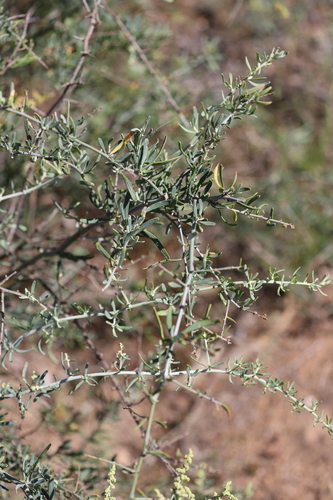
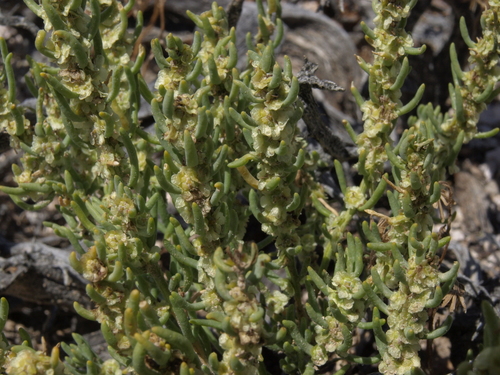
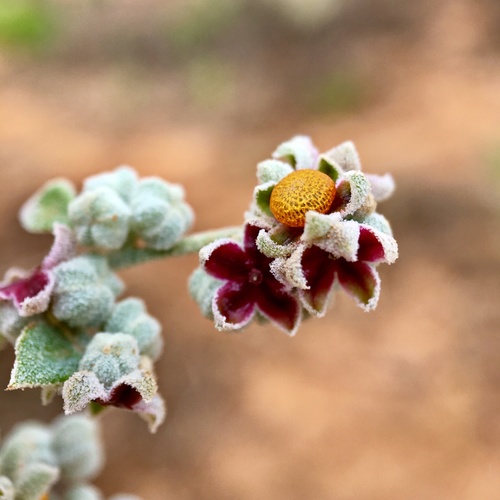
Chenopodium spinescens is a multi-stemmed dense shrub that grows up to 2 metres (7 ft) tall, with branches that often end in spines. Its leaves are arranged alternately or oppositely, and have a mealy texture; they appear grey-green to almost whitish due to a covering of saucer-shaped or spherical hairs. Leaves range in shape from ovate to triangular, measuring 5–17 millimetres (0.2–0.7 in) long and 5–17 millimetres (0.2–0.7 in) wide. The leaf petiole is approximately half the length of the leaf lamina. Male and female flowers typically grow on separate plants. Flowers have five tiny, uniform perianth segments and five stamens. The inflorescence takes the form of a panicle or spike, and the outer surface of the flower perianth is densely mealy. Male flowers are globular, 0.5–1 mm in diameter, and have filaments united into a smooth, saucer-shaped disc. Female flowers are larger, around 1 mm across, and shaped from globular to top-shaped. Ripe fruit is a depressed globular, pink or red, succulent berry. The seed is approximately 1 millimetre (0.04 in) in diameter and has a reticulate coat. In the Northern Territory, this species flowers and fruits from February to December; in Victoria, it flowers from January to April. In the Northern Territory, its habitat includes sandplains, alluvial plains, intermittent sandy watercourses, and sandy edges of salt lakes, and it rarely occurs on gravelly hillslopes. In Victoria, it usually grows on heavy, saline or subsaline soils at the edges of lakes, on flats, and in dune swales. It is found in the following IBRA bioregions: Burt Plain, Central Ranges, Channel Country, Coolgardie, Finke, Flinders Lofty Block, Gawler, Great Sandy Desert, Great Victoria Desert, MacDonnell Ranges, Mitchell Grass Downs, Nullarbor, Riverina, Simpson Strzelecki Dunefields, Stony Plains, and Tanami. Bioregions from Victoria, Queensland and New South Wales may not be included in this list.