About Chenopodium quinoa Willd.
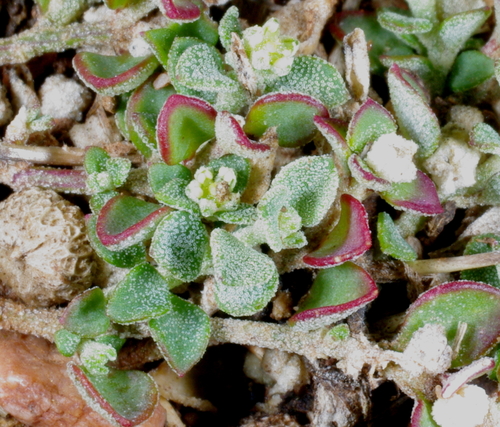
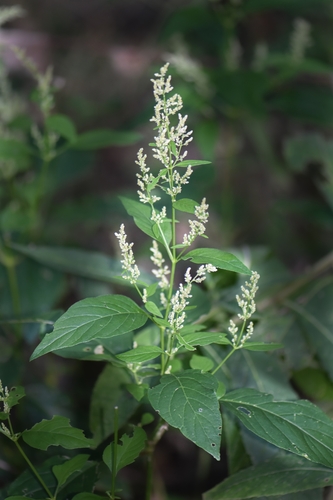
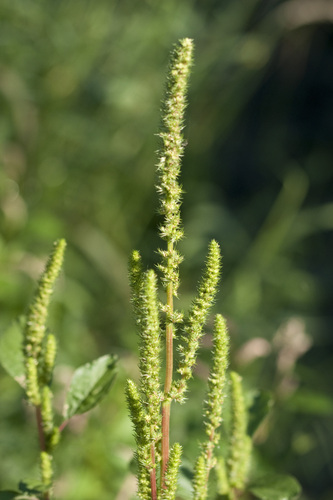
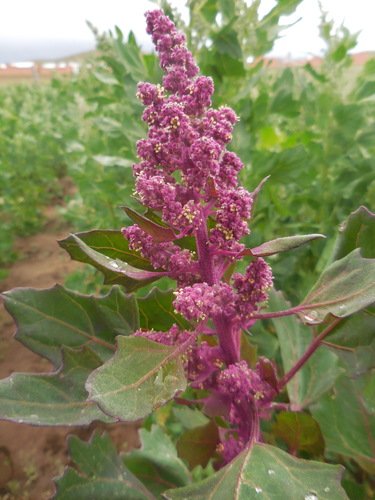
Chenopodium quinoa Willd. is a dicotyledonous annual plant that usually grows 1–2 m (3–7 ft) high. It has broad, generally powdery, hairy, lobed leaves that are normally arranged alternately. Its woody central stem is branched or unbranched depending on variety, and may be green, red or purple. Flowering panicles grow from the top of the plant or from leaf axils along the stem. Each panicle has a central axis that produces a secondary axis, which either holds flowers directly (in the amaranthiform arrangement) or bears a tertiary axis that carries the flowers (in the glomeruliform arrangement). The flowers are small, incomplete, sessile, and match the color of their sepals. Both pistillate and perfect flower forms occur: pistillate flowers are generally located at the proximal end of glomeruli, while perfect flowers are found at the distal end. A perfect flower has five sepals, five anthers, and a superior ovary, from which two to three stigmatic branches emerge. These green hypogynous flowers have a simple perianth, and are generally self-fertilizing, though cross-pollination also occurs. In natural environments, betalains attract animals to increase pollination rates and help ensure or improve seed dissemination. The edible fruits (seeds) are around 2 mm (1⁄16 in) in diameter, and come in a range of colors from white to red or black, depending on the cultivar. Studies of Chenopodium quinoa’s salinity resistance have concluded that accumulated organic osmolytes serve a dual role for the species: they provide osmotic adjustment, as well as protection against oxidative stress to the photosynthetic structures of developing leaves. Studies also suggest that reducing stomatal density in response to increasing salinity is a key defense adaptation that optimizes water use efficiency under saline growing conditions. Chenopodium quinoa is believed to have been domesticated in the area surrounding Lake Titicaca, in the Bolivian and Peruvian Andes, from wild or weedy populations of the same species. Non-cultivated quinoa plants (Chenopodium quinoa var. melanospermum) grow in the same region where quinoa is cultivated; these may be related to the species’ wild predecessors, or they could be descendants of already cultivated quinoa plants. Over the last 5,000 years, the biogeography of Chenopodium quinoa has changed dramatically, driven largely by human influence, convenience, and preference. This change has affected both the plant’s distribution range and the climates it can successfully grow in today, compared to the climate it originally adapted to. Starting over 3,000 years ago, people in Chile, building on work begun by earlier pre-Inca South American indigenous cultures, have adapted quinoa to tolerate salinity and other environmental stresses. Quinoa was cultivated early on the northern Chile coast by the Chinchorro culture, and was brought early from the Andean highlands to the lowlands of south-central Chile. Varieties grown in south-central Chilean lowlands descend directly from ancestral cultivars that have evolved in parallel with highland varieties. Genetic evidence suggests quinoa was introduced to the lowlands before highland varieties with floury perisperm developed. There is wide disagreement over the date of this introduction: one study places it around 1000 BC, while another places it between 600–1100 AD. During colonial times, quinoa was cultivated as far south as the Chiloé Archipelago and the shores of Nahuel Huapi Lake. Quinoa bread was part of Chiloé’s traditional cuisine until at least the mid-19th century. In Chile, quinoa cultivation had almost disappeared by the early 1940s; as of 2015, the crop is mostly grown in three distinct areas by only around 300 smallholder farmers: indigenous small-scale growers near the Bolivia border grow many types of Bolivian quinoa; a small number of farmers in central Chile grow only a white-seeded variety, marketed through a well-known cooperative; and in southern Chile, women grow quinoa in home gardens within Mapuche reserves. Evidence from Lake Pacucha, Peru, shows that when Amaranthaceae abundance was high, the lake was fresh, and low Amaranthaceae presence indicates drought that turned the lake into a saltmarsh. Based on pollen linked to past soil manipulation, this Andean region was one site where quinoa domestication became popular, though it was not the only one. Quinoa was domesticated in multiple separate geographical zones, leading to morphological adaptations that have resulted in five distinct ecotypes today. Quinoa’s genetic diversity confirms that it has long been and remains a vital crop. Andean agronomists and nutrition scientists began researching quinoa in the early 20th century, and it became a major focus for researchers studying neglected and underutilized crops in the 1970s. In 2004, international interest in quinoa grew substantially, and the crop entered an economic boom and bust cycle that lasted over ten years. Between 2004 and 2011, global interest in quinoa rose and it became a much more notable commodity, with Bolivia and Peru as the only major producers at that time. In 2013, imports of quinoa to the United States, Canada, and multiple European countries increased extremely sharply. Growth began to slow in 2016: imports still increased, but at a much slower rate, and quinoa prices declined as more countries began producing the crop. By 2015, over 75 countries produced quinoa, up from just eight countries in the 1980s. Thanks especially to the wide diversity of Chilean landraces and the species’ adaptation to many different latitudes, quinoa can now potentially be cultivated almost anywhere in the world. Growing global demand for quinoa is partly driven by its recognition as a food that may help reduce food insecurity in some regions. Quinoa is high in protein, making it a common meat alternative for vegetarians and vegans, as well as for people with lactose intolerance. It also contains high concentrations of dietary minerals, and does not contain gluten. These characteristics have increased demand among economically privileged consumers in North America, which has contributed to higher quinoa prices. Quinoa has long been an important staple food for Indigenous peoples of the Andean Altiplano, especially Aymara and Quechua communities. Historically, it was consumed as a subsistence food, and was devalued by Spanish colonizers when they took control of the region. For these Indigenous communities, quinoa cultivation supports food security and well-being, and quinoa was historically included in almost every daily meal.