About Chenopodium curvispicatum Paul G.Wilson
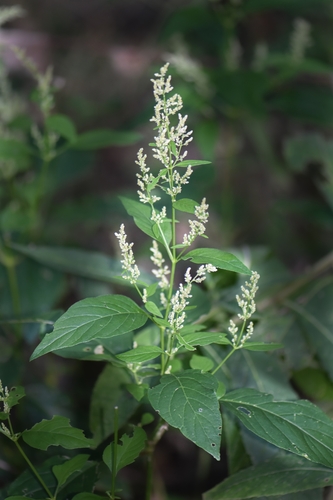
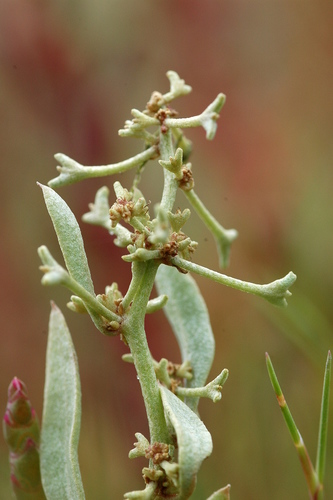
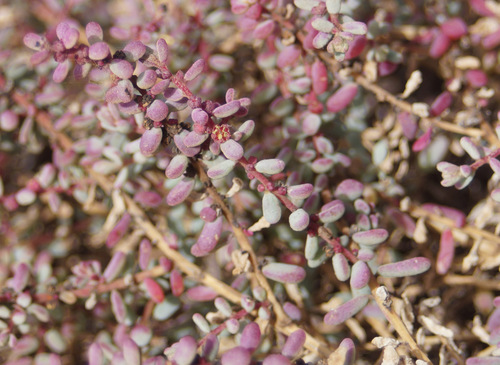
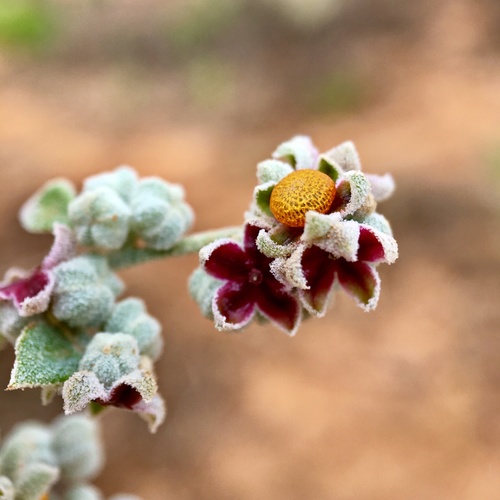
Chenopodium curvispicatum is a straggly shrub that grows up to 1 meter tall, with slender drooping branches covered in dense vesicular hairs. Its leaves are opposite or sub-opposite, deltoid in shape, and measure 1 to 1.5 centimeters in both length and width. The leaves are covered in white rounded hairs that form a silvery layer across their surface. The plant produces flowers that are either male or bisexual, arranged in pyramidal panicles 2 to 5 centimeters long; female flowers grow below male flowers on the panicle. The developing fruit remains enveloped until maturity, when it opens to reach 5 millimeters in diameter and turns red. The fruit is a juicy berry that changes color from red to orange as it dries. This species grows in well-drained calcareous limestone soils in semi-arid sand plain woodlands. Many of its habitats have been degraded by overgrazing, and are also impacted by feral goats and rabbits. Plants in the Chenopodium family are key understorey components of these plant communities, and understorey shrubs in these arid environments provide valuable habitat and resources for many herb and grass species. A common plant community that hosts Chenopodium curvispicatum is Casuarina pauper/Alectryon oleifolius woodland and Eucalyptus shrubland in semi-arid areas of Nanya Station, in western New South Wales. These ecological communities are unique examples of intact vegetation that are rarely found in New South Wales. The seeds of Chenopodium curvispicatum are rounded, 1.5 millimeters in diameter, black, and have a honeycomb-patterned surface. Seeds are dispersed from mature fruiting flowers between March and September.