About Chenopodium album L.
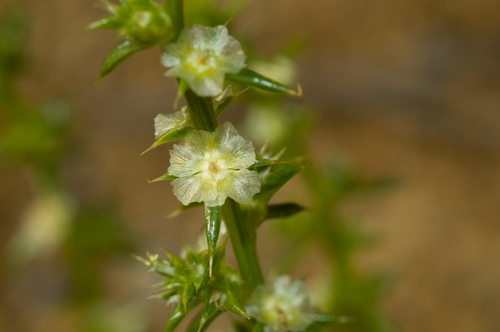
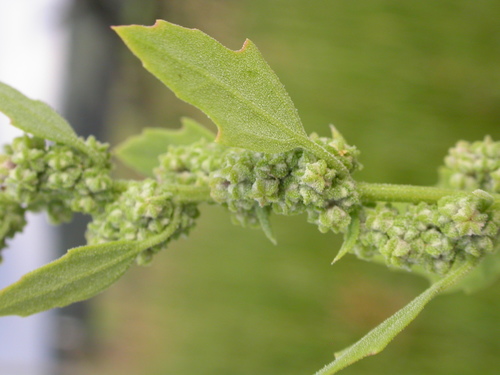
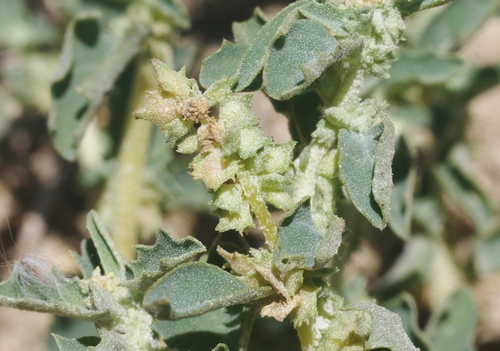
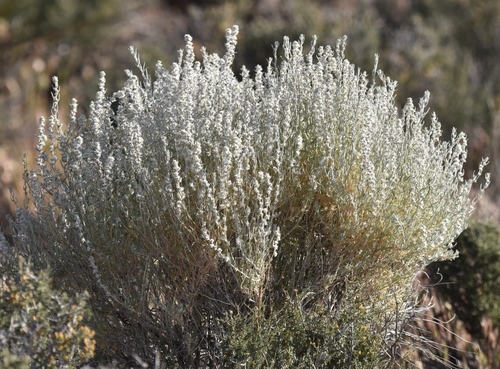
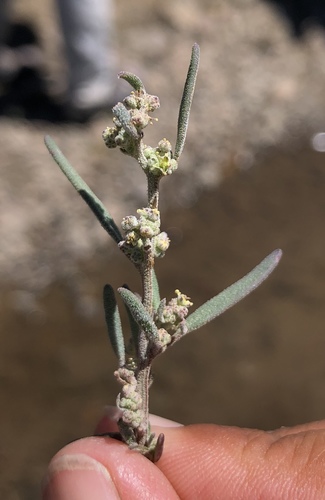
Chenopodium album L. typically grows upright initially, reaching heights of 10–150 cm (4–59 in), and rarely reaches up to 3 m. After flowering, it usually becomes recumbent due to the weight of its foliage and seeds, unless it is supported by other plants. Its leaves are arranged alternately and vary in appearance. The earliest leaves growing near the plant base are toothed, roughly diamond-shaped, 3–7 cm long and 3–6 cm broad. Leaves on the upper section of the flowering stems are entire, lanceolate-rhomboid, 1–5 cm long and 0.4–2 cm broad. These upper leaves have a waxy coating that makes them unwettable, with a mealy appearance and a whitish coat on their underside. The small flowers are radially symmetrical, and grow in small cymes on a dense branched inflorescence 10–40 cm long. Flowers can be bisexual or female, with five tepals that are mealy on the outer surface and shortly united at the base. There are five stamens per flower.
The native range of Chenopodium album L. is unclear because of extensive cultivation, but it includes most of Europe, where Carl Linnaeus formally described the species in 1753. Plants native to eastern Asia are classified under C. album, but often differ from European specimens. According to Plants of the World Online, the species' natural distribution covers temperate Eurasia from western Europe to China and the Russian Far East, the Indian subcontinent, North Africa, Ethiopia, and the eastern and central United States. It is widely naturalized in other regions, including Africa, Australasia, North America, and Oceania, and now occurs almost everywhere except Antarctica. It grows in nitrogen-rich soils, especially on wasteland.
Young shoots of Chenopodium album L. can be eaten raw or cooked, while its leaves are preferably cooked. Flower buds and flowers can also be eaten after cooking. A single plant can produce tens of thousands of black seeds. Quinoa, a close relative of this species, is grown specifically for its seeds. The Zuni people cook the young green leaves of this plant. Archaeologists analyzing carbonized plant remains from storage pits and ovens at Iron Age, Viking Age, and Roman sites in Europe have found this species' seeds mixed with conventional grains, and even inside the stomachs of Danish bog bodies.
In India, the plant is called bathua and grows abundantly during the winter season. Its leaves and young shoots are used in dishes including soups, curries, and stuffed paratha breads, which are common in North India. Its seeds or grains are used in phambra, a gruel-type dish from Himachal Pradesh, and in mildly alcoholic fermented beverages such as soora and ghanti. In the state of Haryana, bathue ka raita, a yogurt accompaniment made with this plant, is commonly eaten in winter. In Nepal, the plant is known as bethe or bethu. It is used to make a dish called saag, where leaves are stir-fried with spices, chili, and diced garlic. A fermented dish called masaura is also made by dipping the leaves in spiced lentil batter, then sun-drying them for several days. The fermented masaura can be cooked into a curry and served with rice.