About Chelone obliqua L.
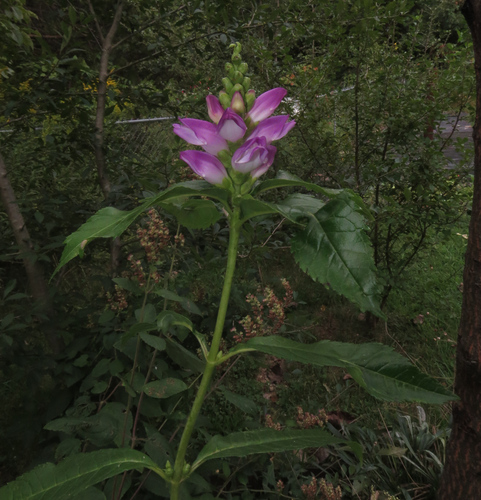
Chelone obliqua L. is an herbaceous perennial plant that reaches 2 to 3 feet (61 to 91 cm) in height and spreads 1 to 2 feet (30 to 61 cm) wide. Its central stem is light green, smooth, hairless, and cylindrical, with pairs of opposite drooping leaves arranged along it. Leaf blades range from lanceolate to broadly lanceolate, are hairless, and have serrated margins. The upper leaf surface is dark green, while the lower surface is paler green. Each leaf blade has a petiole at its base. This species blooms later than many other herbaceous perennials, with flowering occurring in mid to late summer. Its flowers are tubular and two-lipped, with a small yellow beard inside the lower lip of each bloom. Flowers have no floral scent, are cross-pollinated by bees, and are attractive to butterflies. After flower corollas turn brown and fall off, an ovoid seed capsule develops. Seed capsules are initially light green and uncovered with no coating, later turning brown and splitting open to release seeds. This plant is rhizomatous, and occasionally forms vegetative colonies. This species is native to multiple states in the eastern and central United States, specifically Arkansas, Alabama, Florida, Georgia, Illinois, Iowa, Indiana, Kentucky, Massachusetts, Maryland, Michigan, Minnesota, Missouri, Mississippi, North Carolina, South Carolina, Tennessee, and Virginia. Populations are tetraploid in the Blue Ridge Mountains, and hexaploid in regions from Tennessee to Arkansas and Michigan, as well as on the Atlantic coastal plain from South Carolina to Maryland. The species has arisen multiple times from diploid ancestors of the three other species in the genus Chelone: C. glabra, C. lyonii, and C. cuthbertii. Chelone obliqua is cultivated as an ornamental plant. Its optimal bloom period falls in July and August. Seed dispersal occurs in early spring; plants can be divided in mid-spring, and root soft-tip cuttings can be taken in early summer. It grows best in moist to wet, rich, humusy soils in locations with full sun or partial shade. It tolerates clay soil, and may benefit from leaf mulch when grown in full sun to prevent the soil from drying out. It can grow in any soil pH, whether neutral, alkaline, or acidic. In the wild, it grows mainly in moist woods, swampy areas, and along streams. Potential cultivation issues include susceptibility to powdery mildew, rust, and fungal leaf spots, as well as damage from slugs and snails.