About Chelmonops truncatus (Kner, 1859)
Species Comparison
Chelmonops truncatus closely resembles its relative the Western talma (C. curiosus). The main difference between the two is that the dorsal fin of C. truncatus is truncated, while the western species has a long filament on its dorsal fin.
Body and Fin Coloration
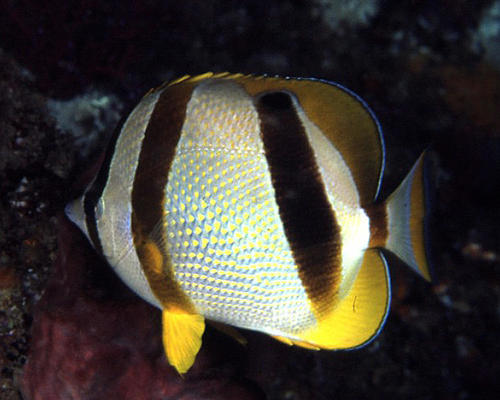
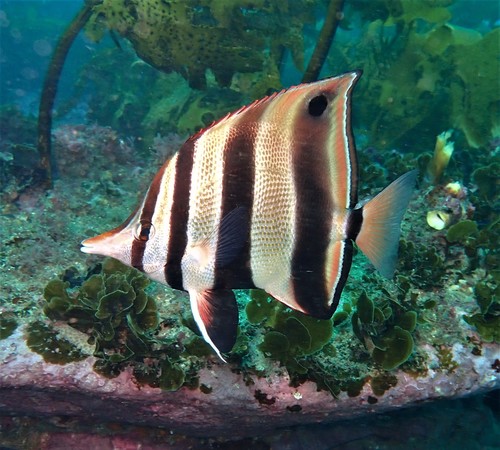
The fins and dark body bands of C. truncatus are often tinged vinaceous, which gives them a dark red appearance in some types of light.
Juvenile Dorsal Fin Marking
Like other butterflyfishes, juvenile C. truncatus have a clear ocellus on the dorsal fin. This marking smudges and becomes less visible as the fish matures.
Dorsal Fin Shape by Age
The smooth profile of the rear section of the dorsal fin is more noticeable in younger fish, and this part of the fin grows slightly elongated in adults.
Soft Fin Margin by Age
In adult C. truncatus, the rear margin of the soft dorsal and anal fins is almost vertical, while juvenile fins are more rounded.
Maximum Size
This species reaches a maximum total length of 22 centimetres, or 8.7 inches.
Geographic Range
C. truncatus is endemic to south-eastern Australia, where its range extends from Double Island Point in southern Queensland south to around Jervis Bay in New South Wales.
Habitat
This species lives in coastal bays and estuaries, along deep rocky walls.
Social Grouping
Adults are typically found in pairs, while juveniles are often found alone.
Diet
Their diet is made up of small crustaceans, worms, and filamentous algae.
Territorial Behavior
Breeding pairs of C. truncatus defend their territories.