About Charaxes guderiana (Dewitz, 1879)
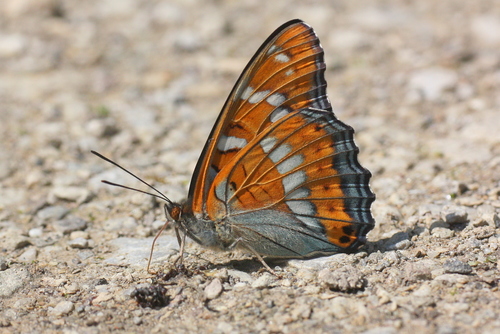
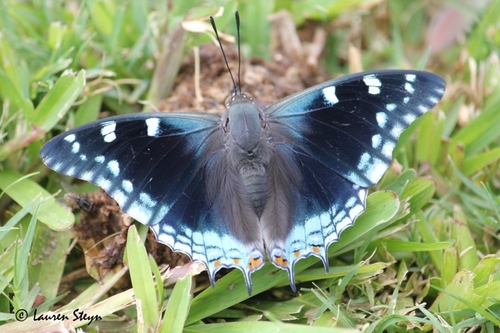
This species has a wingspan of 50–60 mm in males and 60–70 mm in females. For male Charaxes guderiana, the upper side of the wings is black. The base of the forewing is greenish blue, with a large white spot at the end of the cell, two white discal spots in cells 5 and 6, a complete row of 8 postdiscal spots that are white or bluish toward the hindmargin, and large white marginal spots. On the hindwing, there is a blue postdiscal band in cells 2–5, which is only separated by a fine black line from the bluish, white-dotted submarginal streaks; the marginal streaks are thick and white, usually bluish and dotted with yellowish in cells 1c–3. The undersurface of the forewing has two white spots on the costal margin. The female is quite different on the upper side, and strongly resembles Charaxes saturnus and the female of Charaxes achaemenes; it was even described as a variety of Charaxes pelias in 1892. On the upper side of the female's wings, the base is light brown up to vein 3, followed by a shared light orange-yellow median band that extends from vein 2 of the hindwing to vein 4 of the forewing. The forewing also has additional orange-yellow markings: a spot at the apex of the cell, two discal spots in 5 and 6, a postdiscal row of 6 rounded spots in 2–7, and large marginal spots joined into a band; the ground color of the apical part is black. On the hindwing, the median band is followed distally by a deep black band 10 mm in breadth, then the blue, white-centered submarginal spots and the marginal spots, which are thick and bright orange-yellow in cells 4–7, but narrow, greenish and indistinctly dotted with yellow in 1c–3. The undersurface is much lighter than that of the male, and the median band is also present here; the hindwing has red postdiscal lunules. This species occurs from Angola to British East Africa, and is not found in South Africa. A full description was also published by Rothschild, W. and Jordan, K. in 1900 in Novitates Zoologicae Volume 7: 473 and following pages (for wing venation terminology, see Novitates Zoologicae Volume 5: 545-601). The female of Charaxes guderiana is similar to both sexes of Charaxes saturnus and to the female of Charaxes achaemenes.