About Charaxes ethalion (Boisduval, 1847)
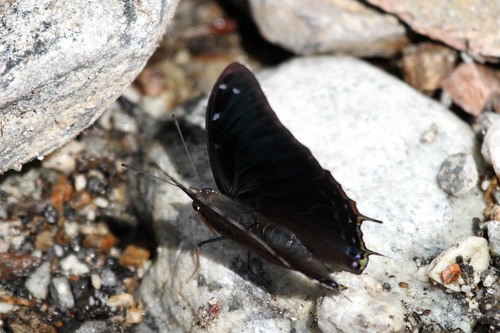
Charaxes ethalion (Boisduval, 1847) is very closely allied to Charaxes etheocles, differing from it only in the male genital armature, and in the female having a unicolorous cell on the upper surface of the forewing, which never has light spots. Males have a wingspan of 45–55 mm, while females have a wingspan of 50–63 mm. For males: the upper surfaces of the wings are velvety black and almost lack metallic gloss. The upper surface of the forewing has no marginal spots, and at most has one postdiscal and one discal spot; the spot in the cell is often absent. The hindwing has small or indistinct whitish submarginal dots, and greenish marginal streaks that are often red-yellow in cellules 4–6. Females are similar to female Charaxes etheocles form etheocles, but have no spot in the cell of the forewing. Their markings can be white, ochre-yellow or bluish. This species ranges from the Cape to British East Africa. The larva is unicolorous green, with a yellowish-bordered spot on the sixth segment. The aberration kitungulensis Strand has two postdiscal spots in cellules 6 and 7, but no other light spots on the forewing, and occurs in German East Africa. A full description of this species was published by Rothschild, W. and Jordan, K. in 1900 in Novitates Zoologicae Volume 7, on pages 478-479; an explanation of descriptive terms can be found in Novitates Zoologicae Volume 5, on pages 545-601.