About Charaxes etesipe (Godart, 1824)
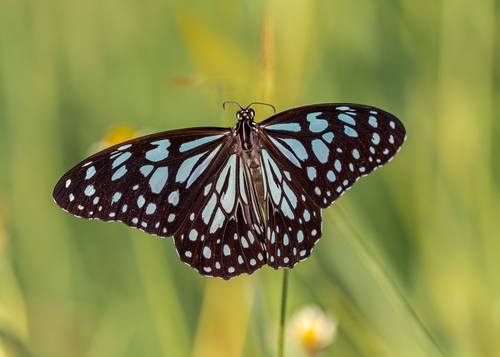
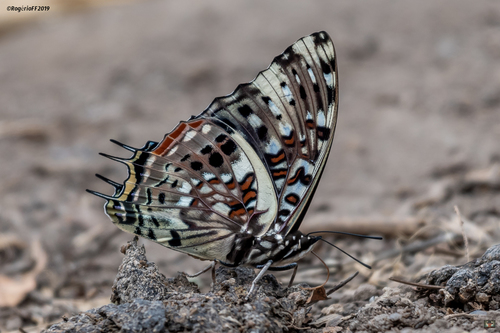
Scientific name: Charaxes etesipe (Godart, 1824). Males have a wingspan of 35–38 millimetres (1.4–1.5 in), while females are larger with a wingspan of 37–45 millimetres (1.5–1.8 in). The uppersides of the forewings are blackish blue with a greenish tint. The outer margins are generally denticulate, or tooth-like, with a series of white discal spots. Hindwings of both sexes have short tails and a complete series of large pale blue patches. The undersides of the wings are variegated with cream and drab colours. A full description was published by Rothschild, W. and Jordan, K., 1900 in Novitates Zoologicae Volume 7:455-457, page 428-429; for term definitions see Novitates Zoologicae Volume 5:545-601. Seitz noted that on the upperside of the male hindwing, the transverse band is blue and positioned beyond the middle of the wing; in the female, this band is at least partly white and positioned around the middle of the wing. The nominate subspecies etesipe Godt. has the following characteristics. In males, the forewing transverse band is narrow, entirely broken into spots. Only spots in cellules 1a, 1b and 2 are blue, all other spots are white, and all spots are positioned near the distal margin. White spots also appear in the basal part of cellules 2–6 and at the apex of the cell. The median band on the upperside of the hindwing is only 2–3 mm in breadth and is also broken into spots. In females of the nominate subspecies, the transverse band on the upper surface is broad and white, while the markings at the distal margin of the hindwing are indistinct. This subspecies ranges from Sierra Leone to Angola and Unyoro. Subspecies abyssinicus Rothsch. differs from the nominate type-form in that the male's blue transverse band of the hindwing is continuous and approximately 5 mm in breadth. The blue spots in cellules 1a and 1b on the upperside of the forewing are also larger than in nominate etesipe. The female of this subspecies is unknown. It occurs in Abyssinia. Subspecies tavetensis Rothsch. has the following characteristics. In males, the blue transverse band on the upperside of the hindwing is posteriorly continuous and very broad (7–8 mm in breadth in cellule 2), but anteriorly much narrowed and broken up into spots. The blue spots in cellules 1a and 1b of the forewing are larger than in nominate etesipe, but smaller than in abyssinicus. Females are very similar to females of typical etesipe, but are somewhat smaller and have more distinct markings at the distal margin of the upperside of the hindwing. This subspecies occurs in East Africa, from Nyassaland to Taveta in British East Africa. This species is distributed across tropical east and west Africa and Madagascar, occupying a mosaic of habitats, but occurs mainly in Afrotropical forest.