About Charaxes brutus (Cramer)
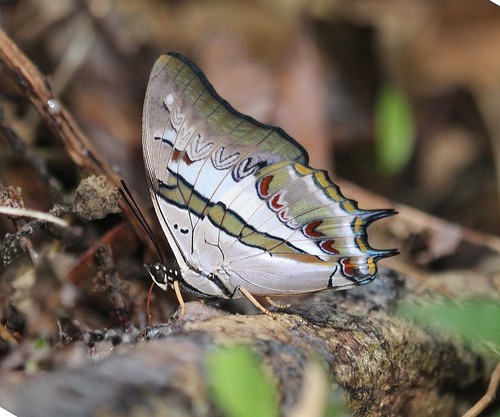
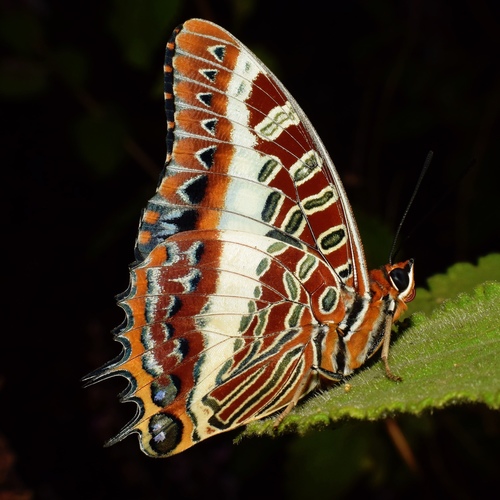
Charaxes brutus (Cramer) has an average wingspan of 60–75 mm in males and 75–90 mm in females. The upper surface of both wings is black or black-brown, marked with a shared white or whitish yellow discal band. On the forewing, this band breaks into spots near the costal margin. Marginal spots are absent on the upper surface, but the hindwing has 2–4 small blue spots before the distal margin: 2 in cellule 1c, and one each in cellules 2 and 3. The underside of the wings has a continuous white discal band. The ground color of the basal portion is red-brown, with sharply defined black, white-edged markings characteristic of the Charaxes genus. Next to the discal band, the marginal portion is brown-yellow, and is further ornamented with large triangular black spots that are bordered distally with pale grey. The hindwing also has a distinct but short tail at vein 3. There are three recognized subspecific forms. The nominate form, C. b. brutus Cr., has a pure white discal band on the upper surface that is not, or only indistinctly, margined with blue; the band also includes a spot in cellule 7 of the forewing, and measures 5–9 mm broad in cellule 1b of the forewing. It occurs from Sierra Leone to the Niger. C. b. natalensis Stgr. differs from the nominate form only in that its discal band is distinctly margined with blue, and its small marginal spots are somewhat more distinct; it is found in East Africa from Natal to Kilimanjaro. C. b. angustus Rothsch. has a much narrower discal band, which measures only 2.5–4 mm broad in cellule 1b of the forewing, and the marginal spots of the forewing are very small or entirely absent. It occurs from Old Calabar to Angola. A full description of the species was published by Rothschild, W. and Jordan, K. in 1900 in Novitates Zoologicae Volume 7, pages 287–524, starting from page 429; for an explanation of morphological terms used, see Novitates Zoologicae Volume 5, pages 545–601.