About Charaxes affinis Butler, 1865
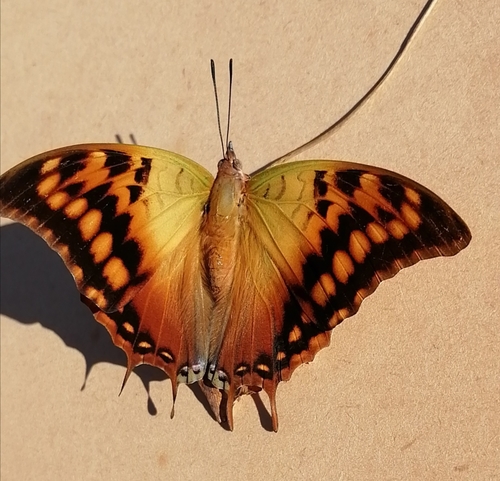
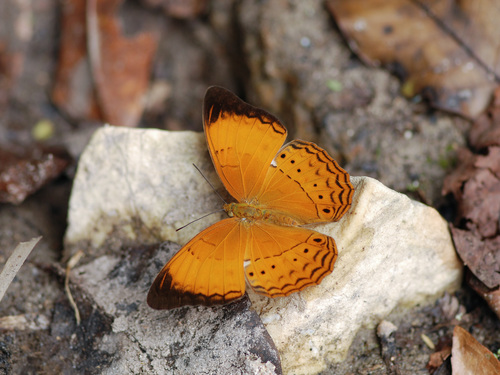
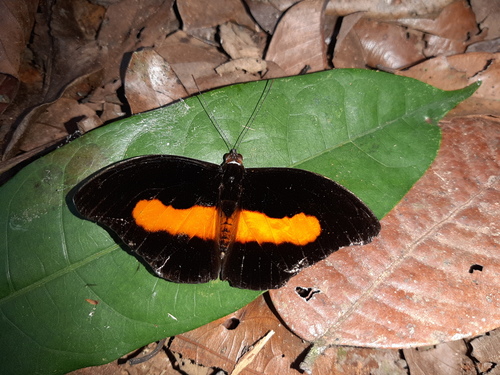
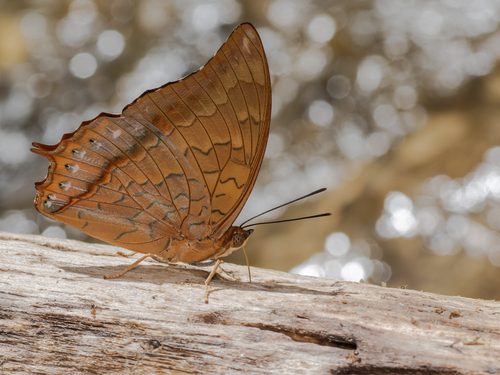
Charaxes affinis is a large, sexually dimorphic butterfly with a wingspan of 66-75mm. The male’s upperside is orange-brown, with a broad dark brown or black marginal band on the forewings, and a submarginal line of brown or black spots plus a small tail on the hindwings. The species’ patterns and colours are extremely variable. For both males and females, the body (especially the thorax) is less bright tawny orange than the wings, and more ochre-coloured. Forewing length ranges from 38–44 mm in males to 50–53 mm in females. Males have bright tawny orange wings, with a largely buff-coloured abdominal fold. Forewings are rather falcate, with an outer edge that is either nearly entire or denticulate; the posterior half or two-thirds of bar D is obsolete. The median bars SC5—R2 are heavy, generally forming triangular patches that are more or less fused with the black outer area, though the second bar sometimes stands quite isolated; the median bar R3—M1 is seldom clearly marked on the upperside, and sits about 6mm from the origin of M1, matching its position on the underside. The black postdisco-marginal area is much narrower behind than at the front, measuring about 4 mm at SM2. The discal bar M2—SM2 is present, either heavy and separated from the black wing border by a small tawny orange spot between veins, or feeble and then more or less completely isolated (apparently in all specimens from North Celebes); the bar M1—M2 also often stands partly separated from the black border. These discal bars are positioned much more distally than the discal bars on the underside. In most individuals, the wing edge has two minute tawny dots between M2 and SM2, and the fringe is white between veins. Hindwing shape is somewhat variable; the anal angle is more prominent in some specimens than in others. The median bar C—SC2 is seldom absent, and in some specimens the bar SC2—R1 is also marked. The postdisco-submarginal patches C—R1 are large, while all other patches are small; the patch SC2-R1 is at least 6 mm long, with extending black scaling. In many specimens, black scaling extends basad for several millimetres along SC2, and all other patches are separated from one another. White submarginal dots within these patches are variable, and often partly absent. The admarginal line is black, sharply marked, and separated from the wing edge; it is generally thin posteriorly between the veins, and generally heavy from C to R3, dilated along the veins and joined to, or partly fused with, the postdisco-submarginal patches. The upper tail is acute, 3–4 mm long, while the second tail is very short, and sometimes no more prominent than the teeth SC2—R2. The underside varies in colour from ochraceous to ochre yellow; glossy areas appear darker (slaty grey) in side light, and the discal interspaces are lighter around the median bars. All bars on the underside are much thinner than those of Charaxes latona. On the forewing, the submedian bar M1—M2 is rather oblique; the bar M2—(SM1) sits about midway between the base of M2 and the bar M1—M2, and is often also oblique; the bar R3—M1 is always positioned consistently in both sexes. Discal bars are more distal than in C. latona, and less arched, with the series not interrupted at R2. Postdiscal patches are very obscurely marked, with ill-defined white patches on their distal side, most of which are mostly very feeble. The upper cell-bar is curved twice, with its middle portion pointing distad; a basal cell-spot is at least vestigial, and the costal margin is somewhat greyish at the base. On the hindwing, the median series of bars is much broken, with no bars contiguous; the bar R3—M1 is several millimetres distant from the base of M1, and does not stand very far from the discal series. The bar R2—R3 is much more distal than the bar R1—R2, so the discal interspace between R2 and M1 is less than half the width of the discal interspace between C and R2. Discal bars are much less arched than in C. latona, with the posterior bars almost straight; the series is not parallel to the outer wing margin: it curves slightly basad from C—R3, then runs nearly straight to SM3, which it reaches close to the anal angle. Postdiscal bars are indistinct, represented by blackish, ill-defined, feebly curved lunules; the interspace between postdiscal bars and discal bars is tawny on the outer side, and more yellow proximally. The admarginal blackish brown line is thin, but well-defined, does not touch the wing edge, and is sometimes interrupted at veins.