About Charaxes achaemenes C.Felder & R.Felder, 1866
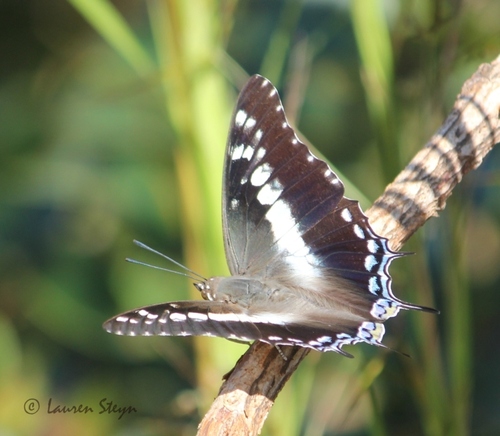
Charaxes achaemenes was described by C. Felder and R. Felder in 1866. Males of this species have a wingspan of 55–60 millimetres (2.2–2.4 in), while females have a wingspan of 60–70 millimetres (2.4–2.8 in). On the upper side of the male's wings, the base is black-grey and the remaining ground color is black. A shared white transverse band runs across both wings: it sits around the middle of the forewing, and slightly before the middle of the hindwing, which means it does not cover the base of cellule 3 on the hindwing. On the forewing, this median band forms single square-shaped spots in cellules 1a—3 and 7, and two widely separated spots in each cellule from 4 to 6; it terminates at vein 2 on the hindwing. The forewing has small, rounded spots at the ends of the interneural folds. The hindwing has whitish marginal streaks, more or less tinged with blue, in cellules 1c-5, and similar submarginal streaks in cellules 1c—7. The underside of the wings is marked nearly identically to Charaxes etesipe, but has a lighter ground color, finer transverse streaks, and a rather sharply defined whitish median band. Females differ from males in several features: the basal part of the upper wing surface is yellow-brown, and the median band is light orange-yellow. The marginal spots on the upperside of the forewing are larger, streak-shaped, and red-yellow. The marginal and submarginal spots of the hindwing are larger, and marginal spots are also distinct in cellules 6 and 7, where they are red-yellow. In appearance, female Charaxes achaemenes strongly resemble Charaxes saturnus and female Charaxes guderiana, but both of those species have completely different underside markings. The aberrant form fasciatus Suff. differs only in having much larger submarginal spots on the upperside of the hindwing; this form has been recorded from Mhonda in German East Africa. A full species description was published by Walter Rothschild and Karl Jordan in 1900, on pages 460–463 of volume 7 of Novitates Zoologicae; explanation of anatomical terms can be found on pages 545–601 of volume 5 of the same journal.