About Chamaenerion latifolium (L.) Sweet
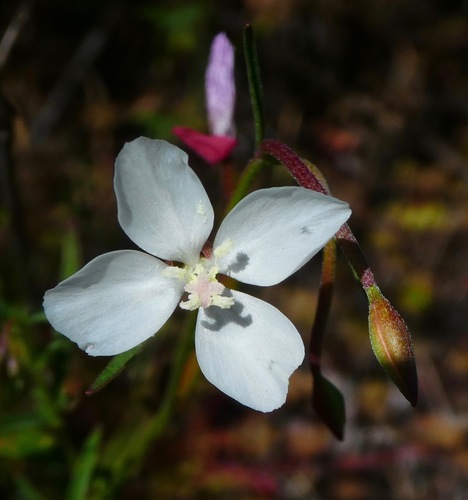
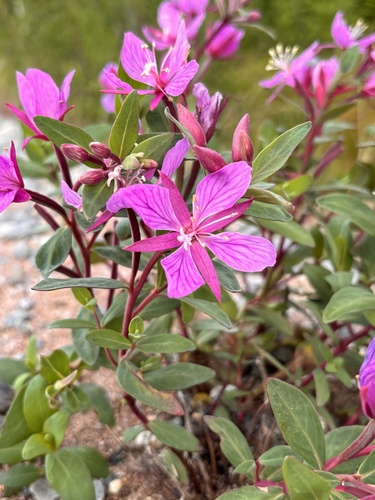
Chamaenerion latifolium (previously classified as Epilobium latifolium, also referenced as Chamerion latifolium) is a species of flowering plant in the evening primrose family. Its English common names are dwarf fireweed and river beauty willowherb, and it is also known simply as River Beauty in the Canadian tundra. This species has a circumboreal distribution, found across all northern regions of the Northern Hemisphere, including alpine, sub-Arctic, and Arctic habitats. It grows in environments such as snowmelt-flooded gravel bars and talus, across a wide range of elevations. It is a perennial herb that grows in clumps of leaves with variable size, shape, and texture, growing above a woody caudex. Its leaves measure 1 to 10 centimeters long, range from lance-shaped to oval, have either pointed or rounded tips, and can be hairy to hairless with a waxy texture. The inflorescence is a rough-haired raceme holding nodding flowers. The flower petals are bright to deep pink, occasionally white, and can grow up to 3 centimeters long. Pointed sepals sit behind the open petals. The fruit is an elongated capsule that may reach over 10 centimeters in length. In the Arctic, this plant provides valuable nutrition for the Inuit. Inuit people eat the leaves raw, boiled with fat, or steeped in water for tea; the flowers and fruits are eaten raw, and the plant is also served as a salad alongside meals of seal and walrus blubber. The leaves and shoots are edible, with a flavor very similar to spinach. This is the national flower of Greenland, where it is called niviarsiaq, which translates to "young girl".