About Chamaedorea elegans Mart.
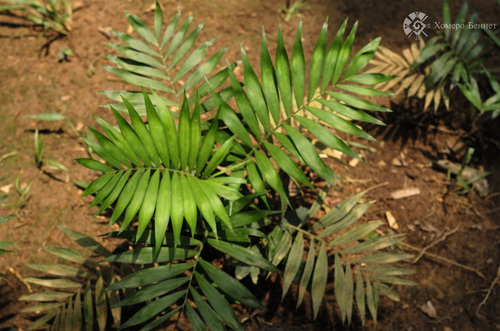
Chamaedorea elegans Mart. is a woody, rhizomatous palm with a slender green, flexible tubular spineless stem, and typically reaches 2–3 m (6 ft 7 in – 9 ft 10 in) in height, rarely growing to 4–5 m (13–16 ft). It has ringed stigmas 1.2 centimetres (1⁄2 in) long, punctured crescent-shaped leaves, erect buds, and generally pinnate foliage. Its crown holds 3 to 10 long pinnate leaves, with more leaves produced as the plant matures. A notable trait of this species is that it begins flowering at an early age, with some individuals blooming when only 30 centimetres (12 in) tall. Small, fragrant flowers that are light yellow, yellow, or orange-red grow on irregularly branched peduncles positioned below or among leaves. These flowers emerge as lateral buds from the trunk and open into clusters of small, petalless balls that bear a resemblance to mimosa flowers. After flowering, pea-sized dark berries 6 millimetres in diameter occasionally develop, held in paniculate inflorescences. In the wild, this species occurs in Belize, the Gulf of Mexico, and multiple Mexican states: Chiapas, Campeche, Guerrero, Hidalgo, Oaxaca, Puebla, Quintana Roo, San Luis Potosí, Tabasco, Veracruz, and Yucatan. In Guatemala, it is found in Huehuetenango, Alta Verapaz, and Petén Department. Chamaedorea elegans is commonly cultivated as a houseplant in temperate regions, and grown in gardens in the Southeastern United States, where it grows very slowly to 2 m (6 ft 7 in) tall. It is most often planted and sold in groups of 5 to 30 seedlings. Over time, a small number of stronger seedlings begin to dominate, as smaller weaker seedlings are outcompeted for light and eventually die. Within a few years of purchase, only a few survivors remain, which develop stems and can live for many decades in a pot. It tolerates low humidity and low light, though it prefers medium to high humidity and bright indirect light. It cannot tolerate frost and must be kept indoors during winter in non-tropical climates. It grows best in light potting soil with good humidity and moderate lighting without direct sunlight, but it can adapt to some dryness, high humidity, or reduced lighting. In winter, it is best for the room holding the plant to stay between 12–14 °C (53+1⁄2–57 °F). This plant was very popular in the Victorian era, as it survived the dark, often unheated British homes of the period, and grew well in the greenhouses used to cultivate fashionable exotic plants at that time. Propagation of this species is done exclusively by seed. In its native rainforest floor habitat, the parlor palm often grows competing with vines. It is sometimes found growing along supporting rock walls. Due to its thin stem, wild palms growing in open areas sometimes topple over during storms. Mature plants with adventitious roots can re-root from their fallen position thanks to their rhizomatous roots. Potted plants can be pruned carefully: older lower leaves can be cut at the base of the leaf stem, but removing the growing point (the apical meristem or heart) where new leaves emerge at the top of the stem will kill the plant. In mature plants, single stems can be cut off at the base if adventitious roots are present. As the stem grows additional roots, the bottom section of the stem can be removed, and the plant can re-root from roots located higher up the stem.