About Chamaedorea costaricana Oerst.
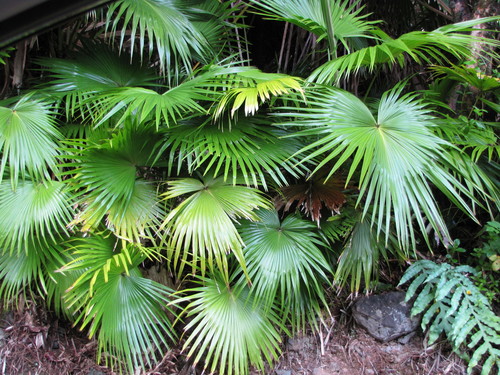
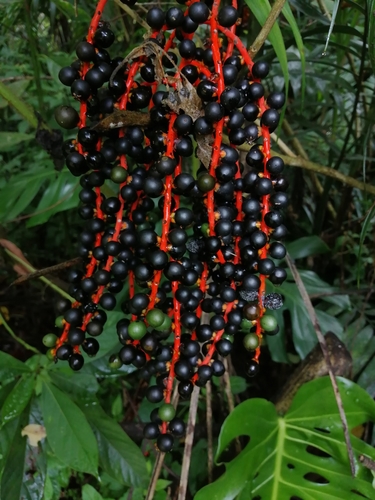
Chamaedorea costaricana Oerst. grows in colonies, with short horizontal stems growing under or at ground level, forming dense or open clumps. Mature clumps reach up to 6 m high, with stems 2-6 cm in diameter and internodes 5-30 cm long. Each stem bears 4 to 6 erect-spreading, pinnate leaves that are 1-2 m long. Each leaf has 20-26 pinnae per side; the pinnae are slightly sigmoid or falcate, 25-40 cm long and 2.5-5 cm wide, with a long acuminate tip. There are 2 prominent nerves on each side of the central main nerve, and the leaf rachis is 100-120 cm long. Leaves have a tubular sheath 20-60 cm long, with an elongated triangular extension opposite the petiole insertion that forms auriculated lobes on each side of the petiole. The petiole grows up to 35 cm long, with a pale band on its abaxial side that extends into the sheath. Inflorescences are infrafoliar and solitary, with a 20-45 cm long peduncle that is erect during flowering and pendulous when carrying fruit. Inflorescences have 5-8 bracts and a 10-20 cm long rachis. Staminate inflorescences have 15-30 flexuous, pendulous rachillae 20-30 cm long, that are green to yellow when flowering. Flowers on staminate inflorescences are 2.5-3.5 mm long and 2.5-3 mm wide, yellow-green; their sepals are almost fully free from the base, and petals are valvate and almost fully free from the base. Pistillate inflorescences have 10-20 rachillae 20-35 cm long, which are frequently only bifid, becoming orange and bulging when carrying fruit. Flowers on pistillate inflorescences are 3-3.5 mm long and 2-2.5 mm wide, arranged in loose spirals, pale yellow, and slightly sunken; their sepals are briefly connate at the base, and petals are imbricate almost to the apex and free. Fruits are globose to subglobose, 7-10 mm in diameter; they are green when unripe and turn black or blackish-purple when ripe. This species is distributed across Mexico and Central America, occurring in Guatemala, Honduras, Costa Rica, Nicaragua, Panama, and El Salvador. It is a common species in humid or very humid forests, cloud forests, and dwarf forests, growing at altitudes between 600 and 1650 meters. It can tolerate full sun, but prefers shade in hot, inland climates.