About Chamaedaphne calyculata (L.) Moench
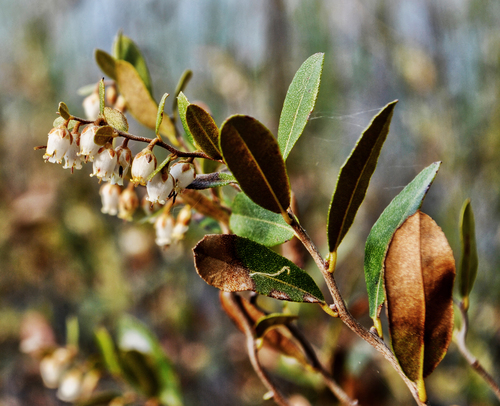
Chamaedaphne calyculata is a low-growing, upright dwarf shrub that reaches up to 1.5 m in height. Its leaves are arranged alternately along branches, and are elliptical to oblong in shape, measuring 1–4 cm long and 0.5–1.5 cm wide. The leaves are thick and leathery, with a dull green upper surface covered in tiny silvery scales, and a paler green or brownish lower surface. Leaf margins are either entire or slightly and irregularly toothed, and leaves have short petioles. This species is evergreen, though its leaves often turn red-brown during winter. Lower stems extend into sphagnum, peat moss, or other substrates, and may remain alive even after fires or mild drought. The plant flowers from April to June, and its flowers are pollinated by insects. Flowers are small, 5–6 mm long, white, bell-shaped, and borne in terminal racemes up to 12 cm long; individual flowers grow from the axils (the junction between leaf and stem) of small leaves on the raceme. Flowers have fused petals with 5 short lobes. The fruit is a capsule, a dry fruit that splits open to release seeds. Chamaedaphne calyculata has a circumboreal distribution across cool temperate and subarctic regions of the Northern Hemisphere, ranging from eastern North America to bogs in Finland and Japan. It grows mostly restricted to bogs, but can also be found in shrubby fens, rock crevices, and pool margins. Leatherleaf (the common name for this species) naturally forms large clonal colonies, and is very shade-intolerant. Bogs have low nutrient availability due to low mineralization, so this plant can only acquire nutrients from atmospheric sources. This plant serves as a food source for the larvae of some Lepidoptera species, including Coleophora ledi. For ornamental purposes, leatherleaf is widely used by florists as a filler green in bouquets and flower arrangements. Ethnobotanically, it is used to make "sun-tea", a drink where dried or fresh leaves are steeped in cool water in a sunny location. This method avoids boiling the plant for a traditional infusion, which risks releasing andromedotoxin, a common toxin found in plants of the family Ericaceae. Leatherleaf also has limited medicinal use among some Native American tribes, who use a poultice of its leaves to treat inflammation.