About Chamaecyparis thyoides (L.) Britton, Sterns & Poggenb.
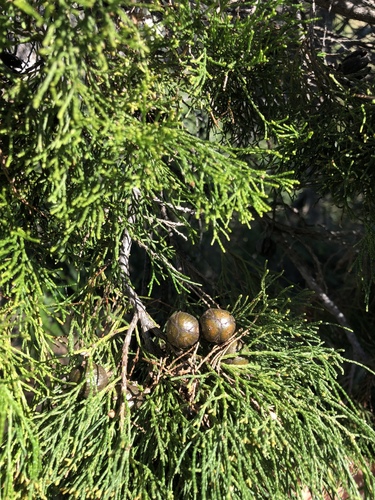
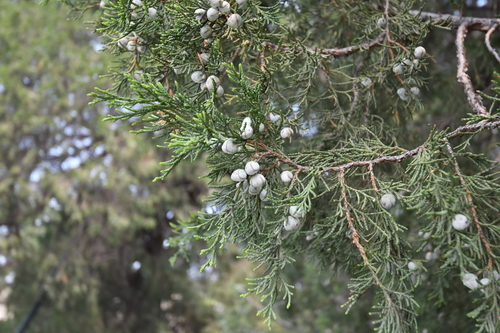
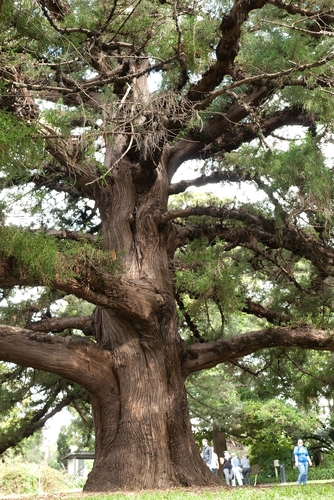
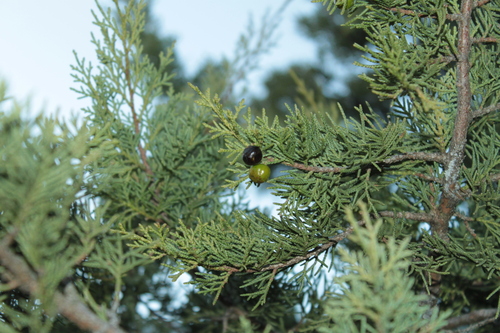
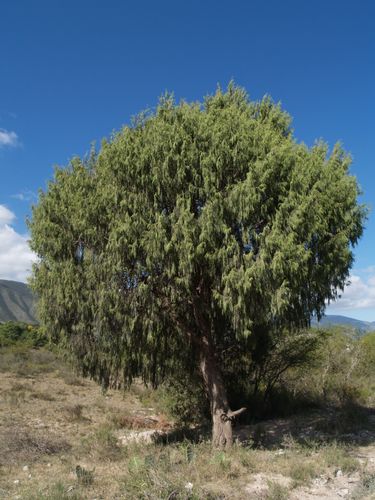
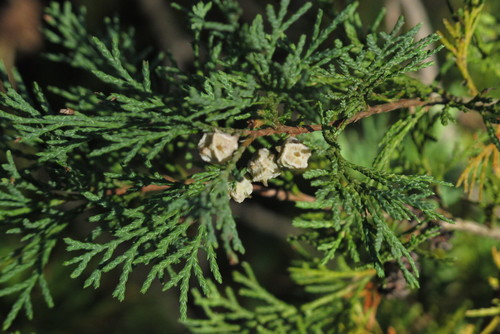
Chamaecyparis thyoides (L.) Britton, Sterns & Poggenb. is an evergreen coniferous tree. It typically grows 20–28 m (66–92 ft) tall, and may reach up to 35 m (115 ft); its average trunk diameter is 0.8 m (2 ft 7 in), and can reach up to 2 m (6 ft 7 in). It has feathery foliage arranged in moderately flattened sprays, colored green to glaucous blue-green. Mature leaves are scale-like, 2–4 mm (3⁄32–5⁄32 in) long, and produced in opposite decussate pairs on slightly flattened shoots; seedlings up to one year old have needle-like leaves. Three-quarters of the trunk height of a mature tree is bare of branches. Its bark ranges from ash-gray to reddish brown: it is smooth on juvenile trees, while mature trees have deeply ridged bark up to 5 cm (2 in) thick. C. thyoides is monoecious, meaning a single tree produces both pollen and seeds in its cones. Seed cones are globose, 4–9 mm (5⁄32–11⁄32 in) in diameter, with 6 to 10 scales that each hold 1-2 seeds. They are green or purple when young, and mature to brown 5–7 months after pollination. Pollen cones are yellow when young, turning brown as they mature, and measure 1.5–3 mm (1⁄16–1⁄8 in) long by 1–2 mm (1⁄32–3⁄32 in) broad. They release their yellow pollen once each year in spring. This species begins bearing seeds at 4–5 years old, but does not reach full maturity or produce full cone crops until it is 10–20 years old. Seeds are dispersed by wind nearly every year. Tree height and diameter grow steadily until the tree is 50 years old, after which height growth slows. Neither height nor diameter increases once the tree reaches 100 years old. Most stands are made up of trees younger than 200 years, though some individuals as old as 1000 years have been recorded. Due to their relatively shallow roots, C. thyoides trees are vulnerable to being blown over by wind. Chamaecyparis thyoides grows within 100 miles of the coastline and below 50 m above sea level along most of the Atlantic East Coast and Gulf Coast of the United States. Rare populations grow in the foothills of the Appalachian Mountains, where the species can be found up to 460 m above sea level. It is protected in multiple U.S. protected areas, including Great Dismal Swamp National Wildlife Refuge, Alligator River National Wildlife Refuge, Pinelands National Reserve, Cape Cod National Seashore, Croatan National Forest, Francis Marion National Forest, Ocala National Forest, and Apalachicola National Forest. Outside of these protected areas, altered fire regimes, logging, and draining of wetlands have all led to a general decrease in the size and number of Atlantic white cedar stands. The species is listed as Rare in Georgia and New York, of Special Concern in Maine, and Extirpated in Pennsylvania. In Mississippi, the species is at risk of extirpation due to overexploitation, changes in land use, and extreme weather events. Chamaecyparis thyoides grows almost exclusively in freshwater wetlands, and is classified as an obligate wetland species. It prefers habitats where soil is saturated with water for at least most of the growing season. Soils in its native habitats have a thick organic layer, often classified as a histic surface horizon, with sandy material at greater depth and poor drainage. Atlantic white cedar wetlands are acidic, and hold very little oxygen in the soil because water has displaced air. Plants living in these environments require special adaptations to these conditions. Throughout Chamaecyparis thyoides's range, red maple and black gum trees are often found in the canopy alongside it, and Sphagnum mosses also commonly grow in these wetlands. The caterpillar of the Hessel's hairstreak butterfly feeds exclusively on C. thyoides, and the caterpillar's green color provides camouflage on the foliage. These trees grow on small mounds called hummocks, with water pooling in the depressions that surround them. This growth habit keeps the tree from being submerged year-round and helps protect it from floods. C. thyoides benefits from periodic low-intensity fires, which expose seedlings to sunlight and limit competition from other canopy species, especially red maple. Too frequent, too intense fires, or excessive flooding can damage seedlings stored in the top layer of soil and harm mature trees. Chamaecyparis thyoides has some importance in horticulture, and several cultivars with varying crown shape, growth rate, and foliage color have been selected for garden planting. Named cultivars include 'Aurea' with yellow foliage, 'Heatherbun' a dwarf cultivar that turns purple in winter, 'Andelyensis' a dwarf with dense foliage, 'Ericoides' which retains juvenile foliage, and 'Glauca' with strongly glaucous foliage. In some locations, particularly Mobile County, Alabama, the tree is cultivated for use as a Christmas tree.