About Chamaecrista nictitans (L.) Moench
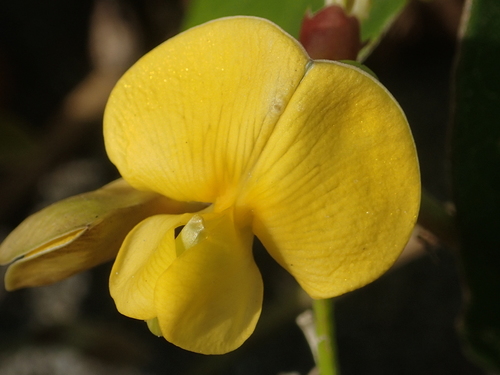
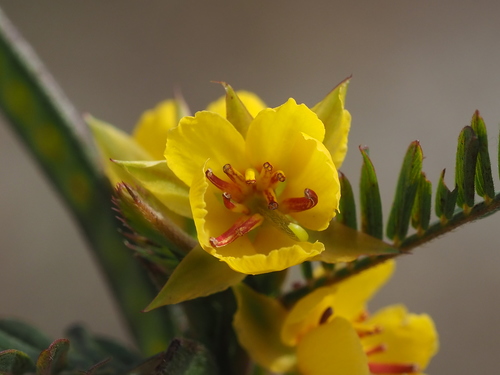
Chamaecrista nictitans (L.) Moench is an annual low-growing herb that grows from a taproot, and often spreads to form extensive mats. Its stems range from hairless (glabrous) to densely covered with incurved trichomes. This plant has sensitive leaves that grow from a slender stalk, with an umbrella-shaped gland around 0.4 to 0.8 mm in diameter. Persistent striate structures are located just below the leaves. Flowers grow in leaf axils, either singly or in groups of two to three, arranged in short racemes. Flower stalks (pedicels) are 1 to 4 mm long. Sepals are lanceolate-acuminate, and measure 3 to 4 mm in length. Petals are bright yellow and unequal in size; the lowermost petal is the largest, at 6 to 8 mm long, roughly twice the size of the other four petals. The plant produces five stamens of unequal length. Its fruit is an elastic dehiscent legume that opens when mature, measuring 2 to 4 cm long and 3 to 6 mm wide. The legume surface ranges from smooth to densely hairy, and may appear shaggy in rare cases. C. nictitans looks similar to Chamaecrista fasciculata, but generally has smaller leaves, is less robust, and has smaller, less conspicuous flowers. C. nictitans is widely distributed across temperate and tropical regions of the Americas, and has been introduced to Hawaii, as well as subtropical and tropical regions of Asia. It can grow in a wide variety of natural and disturbed communities, thanks to its high tolerance for a range of growing conditions. It tolerates overstory canopies and the associated reduction in available light. Historically, the Cherokee tribe used C. nictitans alongside Senna marilandica to treat spasms in infants. It was also used as a cathartic and a vermifuge. While Chamaecrista nictitans is considered undesirable for use as forage or hay, it can be used for both purposes in subtropical areas.