About Chalcosoma moellenkampi Kolbe, 1900
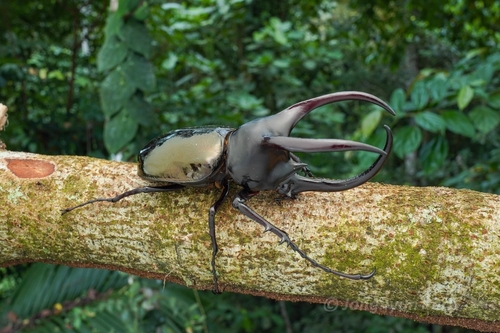
Chalcosoma moellenkampi (scientific name Chalcosoma moellenkampi Kolbe, 1900) reaches approximately the same body size as Chalcosoma atlas. Male Chalcosoma moellenkampi can measure up to 110 mm (4.3 in) from the tip of the head horn to the end of the elytra (wingcases). The largest species in the genus Chalcosoma is Chalcosoma chiron, where males may occasionally reach 130 mm (5.1 in). Females of Chalcosoma moellenkampi are much smaller than males, usually measuring only 45–60 mm (1.8–2.4 in), and they lack horns. Among the three Chalcosoma species, males can be distinguished from each other using specific physical traits, but females of these species are very similar, and usually only specialists can tell them apart. Male Chalcosoma atlas are famous for their three horns: two on the pronotum and one on the head. Due to variation in environmental conditions, not all Chalcosoma moellenkampi larvae grow to the same size, and individuals that develop in harsher conditions mature into small adult beetles. In small male Chalcosoma moellenkampi, the horns are very short, and the head horn extends almost vertically upwards, usually bearing three small prongs. In large males, the horns are enormous, and the head horn projects primarily forward, with an upward curvature. Horn size relative to beetle body size follows positive allometry: in large males, horns are much larger relative to overall body size than they are in small males, which have very short horns. In contrast, females do not have this dramatic difference in body proportions; large females are simply larger versions of small females. Unlike its close relatives C. atlas and C. chiron, C. moellenkampi has a fairly restricted geographic range, and is only known to occur on Borneo.