About Chalciporus rubinellus (Peck) Singer
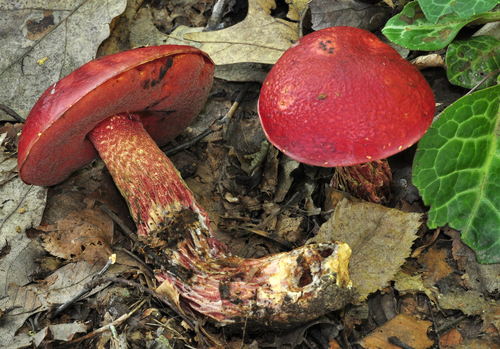
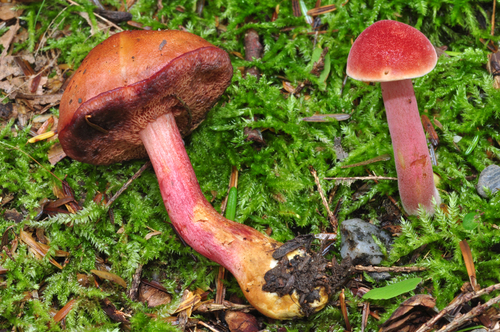
Chalciporus rubinellus (Peck) Singer has a cap that ranges from 1.5 to 5 cm wide, with texture varying from smooth to tufted-hairy, and becomes slimy when wet. Young caps are conical and purple-red, while older caps develop a yellow tint or become reddish brown, turning convex and cracking with age. The flesh is bright yellow and does not change color when bruised. When tested with KOH, the cap stains amber to reddish-brown; ammonia turns the cap blood red, before it shifts to dark orange. This species has white basal mycelium. Its pores are 1.5 mm wide, starting bright red and lightening with age. The tubes are 6 to 10 mm deep, becoming yellowish as they mature. The stipe measures 1 to 6 cm long and 3 to 10 mm thick, has a thread-like texture, and matches the cap in color. Its spores are smooth and spindle-shaped, measuring 12 to 15 μm, and it produces a brown spore print. Scattered pleurocystidia are present, measuring 34–62 by 7–12 μm. Ecologically, Chalciporus rubinellus grows either solitary or in clusters near trees it forms mycorrhizal relationships with, most commonly conifers including spruce, hemlock, and white pine. Fruiting occurs from July to September. For uses, eating Chalciporus rubinellus is not recommended; it has no distinctive odor or taste. It can be used to dye protein-based fabric brown.