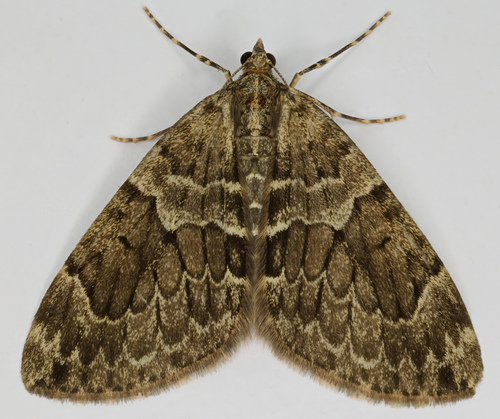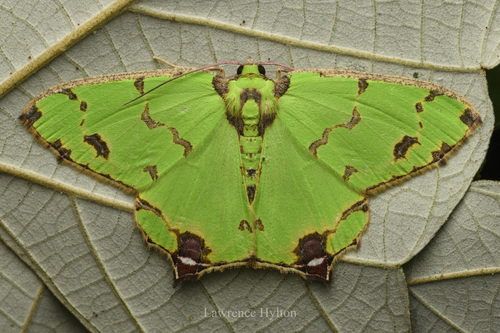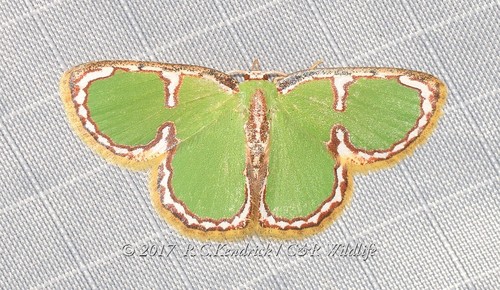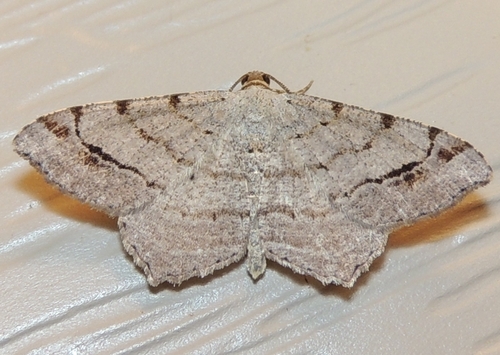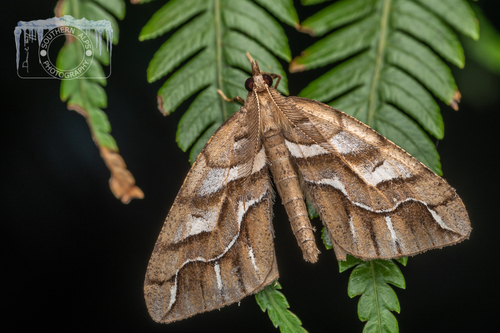
About Chalastra aristarcha (Meyrick, 1892)
Hudson described the larva of Chalastra aristarcha as follows: Before its final moult, it is pale green, with white sub-dorsal and lateral lines and noticeable brown blotches on the sides of each segment, which often meet across the back. The full-grown larva is about 1 inch long, stout, slightly tapered toward the head; it is dull green mottled with white, with yellowish-brown edges on the segments; there are two conspicuous white sub-dorsal lines and two broad, irregular white lateral lines that are narrower at the segmental divisions; the spiracles are brown. Meyrick described the adult male of this species as follows: Male, 37mm. Head, palpi, thorax, abdomen, and legs are pale ochreous, with the back of the crown and the anterior part of the thorax darker; the face has a whitish tint; palpi measure 2+1⁄4; the abdomen and legs are thinly sprinkled with dark fuscous. Antennae are whitish-ochreous, with pectinations 12, and the apical 1⁄6 is simple. Forewings are somewhat elongate-triangular, with the hindmargin almost straight; vein 10 is connected with 9, vein 11 is free; forewings are light yellowish-ochreous, irrorated between veins with pale fuscous and in the disc with white, and veins are a deeper yellow-ochreous; there is a white transverse mark near the base below the middle, edged on the anterior side with ochreous-fuscous; lines are slender, rather cloudy, and dark ochreous-fuscous; the first line is rather strongly curved; the median line is very slightly curved, and the space between this and the first line is suffused with white on the lower two-thirds; the second line is very obtusely angled above the middle, and on the lower half it is completely confluent with the median line to form a narrow shade; there is a white suffusion before the second line toward the angle, which contains a transverse linear dark fuscous discal mark; the subterminal line is far from the hindmargin, running from four-fifths of the costa to the middle of the inner margin, it is slender, dark fuscous, edged with clear white on the anterior side except toward the costa, and is twice sinuate; a clear white longitudinal dash extends from the subterminal line one-quarter below the costa to near the hindmargin, beneath which lies a broad ochreous-fuscous suffusion; the spaces between veins below this dash are suffusedly streaked with fuscous. Hindwings have a rounded, waved hindmargin; they are pale ochreous; there is a slender curved fuscous line beyond the middle, which is obsolete toward the costa; there is a small fuscous spot toward the anal angle. Hudson noted that the species varies slightly in size, that the female is a little darker than the male, and that females can be larger than males. Hudson also pointed out that the adult moth's colouring acts as protective camouflage, because it resembles the dead leaves of its host plant, the silver fern. This silvery banded colouration is also seen in an unrelated moth species that also uses silver fern as a larval host: Ecclitica torogramma. Chalastra aristarcha is endemic to New Zealand, and is found throughout the North Island. In 1966, D. E. Gaskin noted that while Hudson considered this species common in Wellington, Gaskin had not yet collected any specimens there. He believed that the species' range had shrunk as land cultivation expanded. This species lives in dense native forest. The larvae feed during spring, move very slowly, and can be found on the silvery underside of their host plant. C. aristarcha pupates on the ground beneath its host plant, among leaf detritus and moss, and remains in the pupal stage for approximately six weeks. Adult moths are active from October to April, but can sometimes also be observed during the winter months. Gaskin thought there were two broods per year, but was uncertain which life stage C. aristarcha uses to overwinter, as both adults and larvae are present in spring. Adults have been collected by beating their host plant, and have been observed in the evening on flowering Metrosideros perforata. They are attracted to light.