About Chaenactis glabriuscula DC.
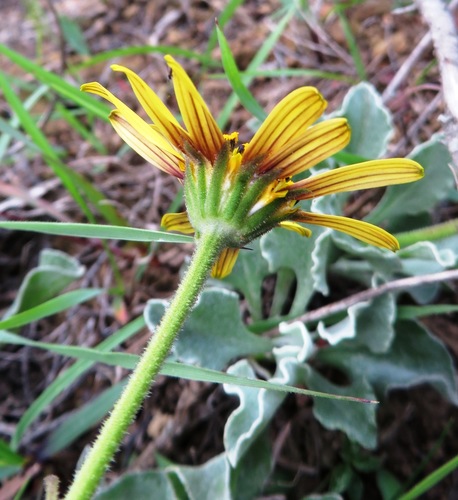
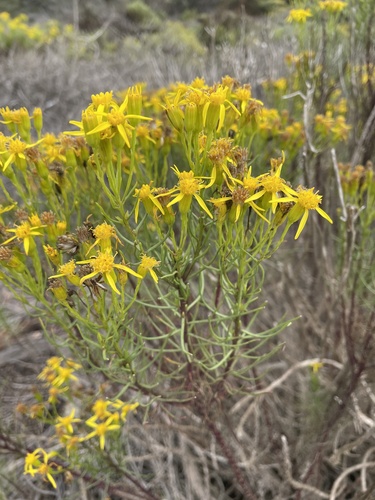
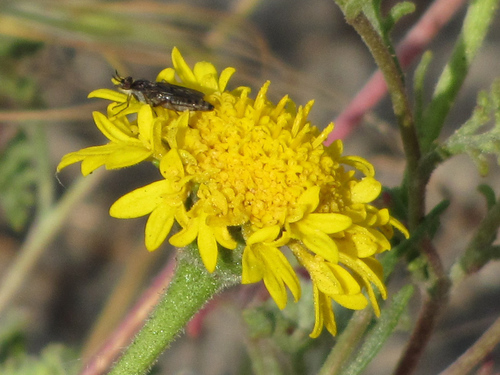
Chaenactis glabriuscula DC. is an annual herb that produces one or more mostly erect stems, reaching a maximum height of close to 50 cm (20 inches). Its branching stems are hairy and often covered in cobweb-like fibers. Its leaves grow up to around 10 centimeters (4 inches) long, are sometimes fleshy, and are typically divided into many very small, curling lobes. The inflorescence bears between one and twenty or more flower heads on a very long, erect peduncle. Each flower head is lined with flat, hairy or woolly glandular phyllaries that measure 4.5–10 mm (0.18–0.39 in). The flower head holds many tubular flowers in shades ranging from gold to bright yellow; the outermost flowers are large and flat-faced, and most have protruding anthers. The fruit is an achene that can measure over a centimeter long when including its layered pappus of scales.
Five accepted varieties of Chaenactis glabriuscula are recognized, with the following ranges: Chaenactis glabriuscula var. glabriuscula ranges from Tehama County, California to Baja California; Chaenactis glabriuscula var. heterocarpha (Torr. & A.Gray ex A.Gray) H.M.Hall ranges from Shasta County to Ventura County, California, with additional scattered populations in Modoc County and San Bernardino County, California; Chaenactis glabriuscula var. lanosa (DC.) H.M.Hall ranges from Fresno County to San Diego County, California; Chaenactis glabriuscula var. megacephala A.Gray ranges from Shasta County to Orange County, California; Chaenactis glabriuscula var. orcuttiana (Greene) H.M.Hall grows along the coast from Ventura County, California to Baja California.
One variety, Chaenactis glabriuscula var. orcuttiana, commonly called Orcutt's yellow pincushion, is a rare variety restricted to the beaches and coastal dunes of Southern California and Baja California, where it is threatened by development of its coastal habitat. New populations of var. orcuttiana were discovered in urban locations along Santa Monica Bay in spring 2010: one in the northern Ballona Wetlands near Venice, California, and another on the dune at Bell Avenue Sand Dune Park recreation area in Manhattan Beach, California, which hosts approximately 185 individual plants. The California Native Plant Society lists this variety as endemic to California dune ecosystems, with a significantly declining population, and confirmed populations in parts of Ventura, Los Angeles, and San Diego counties.
Chaenactis glabriuscula grows in a wide variety of habitats, including the Sierra Nevada, the Mojave and Colorado Deserts, interior chaparral and woodlands, coastal sage and chaparral, and montane chaparral and woodlands ecoregions. It is a variable plant, particularly across its many varieties, and is generally found at elevations below 7,000 feet (2,100 m).