About Chaenactis douglasii (Hook.) Hook. & Arn.
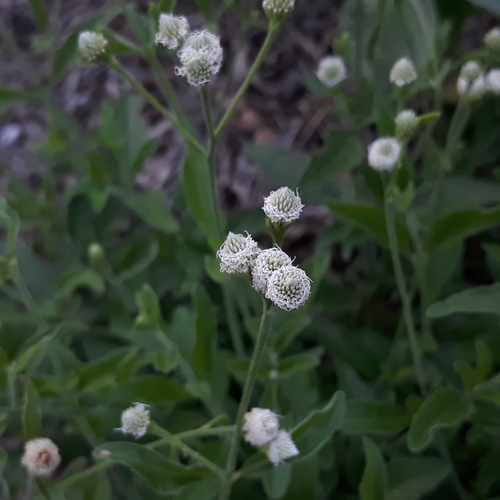
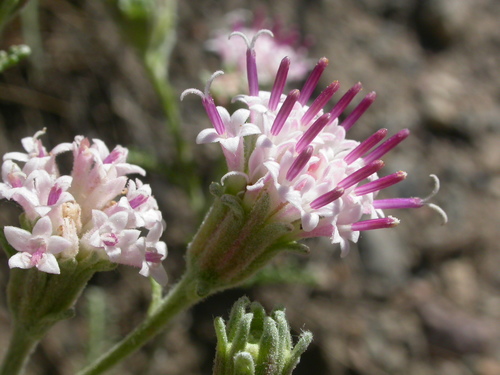
Chaenactis douglasii is a variable herb, most often a perennial. It grows in an erect form, reaching 10 to 60 centimetres (4 to 24 inches) tall, and produces one to many stems covered in cobwebby hairs. Its woolly or hairy leaves can grow up to 15 cm (6 in) long, and are intricately divided into many lobes that have curled or twisted tips. Leaves growing along the stem get smaller and become stalkless toward the top of the stem. The inflorescence bears one or more flower heads, each up to about 2 cm (3⁄4 in) long. This discoid flower head is lined with flat, glandular, blunt-pointed phyllaries, and holds 50 to 70 white or pinkish tubular disc flowers that have protruding anthers. The plant's fruit is an achene about 1 cm (3⁄8 in) long including its pappus of scales. Two recognized varieties of this species are Chaenactis douglasii var. alpina A.Gray and Chaenactis douglasii var. douglasii. This plant is native to western Canada and the western United States. Its range extends from British Columbia east to Saskatchewan, and south from California to New Mexico, with a small number of isolated populations located in Nebraska and the Dakotas. It grows in a wide variety of habitat types, including harsh environments such as alpine rock fields in the Sierra Nevada, areas east of the crest of the Cascade Range in Washington and Oregon, scrubland, desert, and disturbed areas like roadsides. It grows across a broad range of elevations, from sea level up to 4,000 metres (13,000 feet), and occurs most often between 1,800 and 2,400 m (6,000 to 8,000 ft). Some Plateau Indian tribes used this plant as a dressing to treat burns, wounds, and sores.