About Cetrelia chicitae (W.L.Culb.) W.L.Culb. & C.F.Culb.
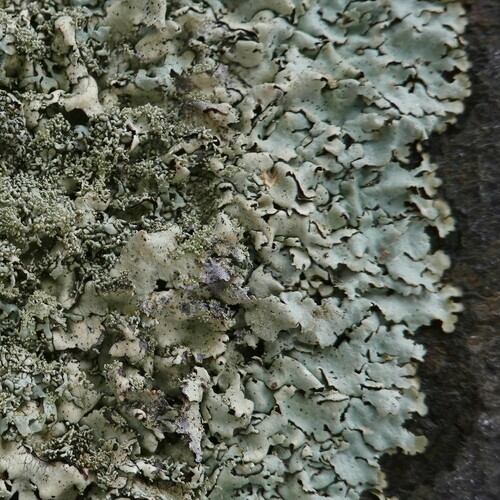
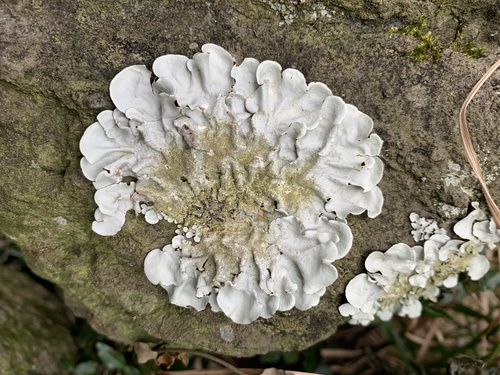
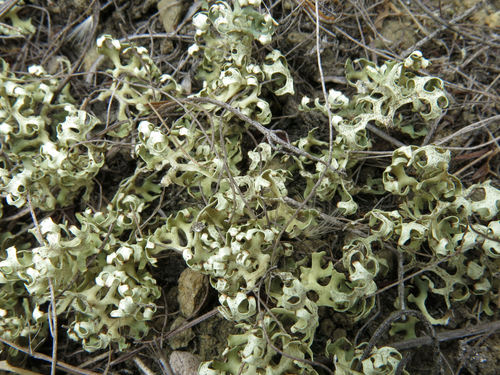
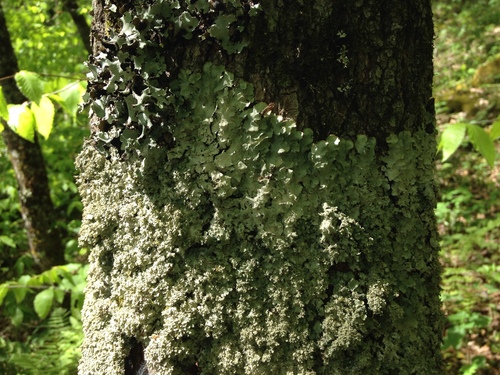
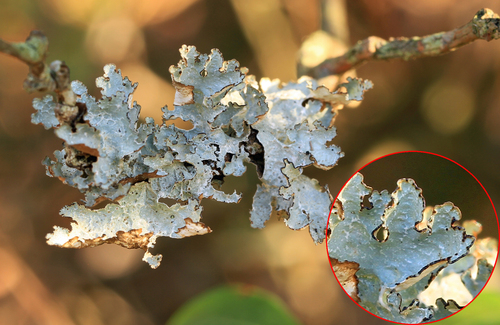
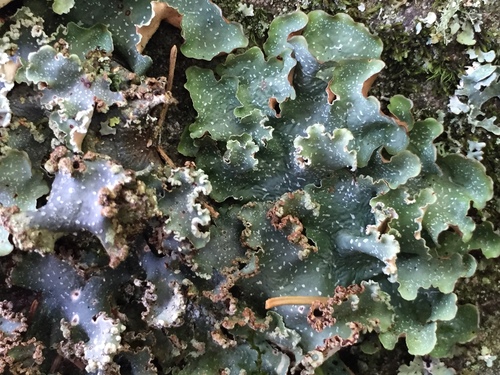
Cetrelia chicitae has a leafy (foliose) thallus that is greenish-gray to pale brownish-gray, made up of broad, undulating lobes 5–20 mm (0.2–0.8 in) across. White powdery to coarsely granular soredia sit on the margins of the lobes on the thallus surface. Pseudocyphellae occur on the upper surface of the thallus, and most measure 0.15–0.6 mm in diameter. The undersurface of the thallus is black to brown, and it sometimes has ivory-colored blotches at the margins. Black rhizines are sparse, and are usually absent from the margins. Secondary metabolites detected in this lichen include atranorin in the upper cortex, and alectoronic acid and α-collatolic acid in the medulla. Analyses of specimens collected in Italy have also found physodic acid in the medulla alongside alectoronic acid and α-collatolic acid. In European specimens, Cetrelia chicitae can be identified by a combination of features: relatively large, typically flat pseudocyphellae that often form even in older, central parts of the thallus, and bands of coarse soredia along strongly twisted lobe tips that give soralia a distinct crenulate (scalloped, bitten-off) look. The lower surface is regularly ridged, with scattered simple black rhizines and a narrow margin that has no rhizines. All Italian collections of this species have so far been sterile, with no apothecia recorded. Cetrelia chicitae grows on both mossy boulders and tree trunks. In east Asia, it has been found in Korea, Japan, and Sakhalin. In North America, its range stretches from New Brunswick west to southern Ontario, and south to Tennessee and North Carolina. It has been recorded in multiple locations across Europe, though it is relatively uncommon there. In Italy, Cetrelia chicitae is the rarest of the four sorediate Cetrelia species, and is only known from five sites in the central-eastern Alps. In this region, it occurs between roughly 870 and 1200 m elevation in humid montane beech, conifer, and mixed beech–conifer forests, most often near streams and in stands that are regularly exposed to rain or fog. Italian populations are restricted to well-preserved forests with confirmed continuity over at least three centuries. Authors consider these sites to have high conservation value, as they support C. chicitae alongside other rare macrolichens characteristic of old, moist montane woodland. Cetrelia chicitae is classified as critically endangered in Poland.