About Cetraria sepincola (Ehrh.) Ach.
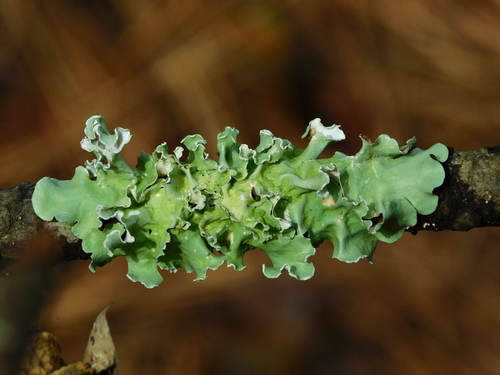
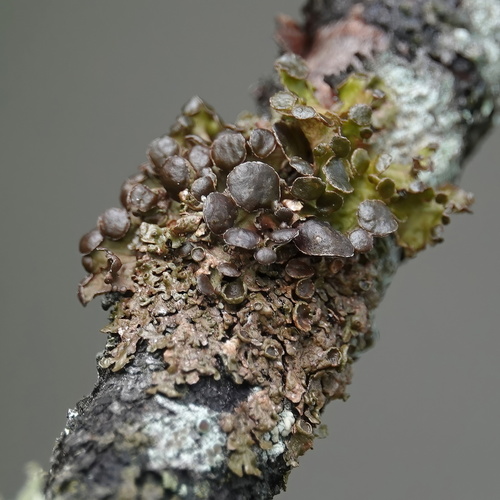
Cetraria sepincola forms compact, cushion-like colonies that are typically 0.5–2 cm (1⁄4–3⁄4 in) high. The lichen body, called a thallus, is mostly single-layered and erect, made up of rounded lobes that are either flat or slightly grooved. These lobes branch in a shallow, forked pattern. The upper surface of the thallus ranges in color from yellowish-green to reddish-brown or dark brown, and often has a wrinkled, glossy texture. The underside is lighter in color, shifting from pale brown near the center to almost white toward the edges, and also has a wrinkled appearance. Sparse, root-like structures called rhizines grow on the lower surface, and fine hair-like cilia are rarely present. This lichen does not produce soredia, the powdery reproductive structures used for dispersal. One distinguishing feature of this species is the presence of small pale spots called pseudocyphellae, which are mostly concentrated near the edges of its reproductive structures, called apothecia. Apothecia are common on this lichen, growing along lobe edges or at lobe tips; they can reach up to 8 mm (3⁄8 in) in diameter, are disk-shaped, and match the color of the thallus. Microscopically, C. sepincola produces elliptical spores that measure 6–10 by 3–6 μm. Tiny black structures called pycnidia, which are slightly raised and typically empty, grow along lobe margins. The asexually produced spores, called conidia, are dumbbell-shaped and measure 5–7 by 1 μm. Cetraria sepincola has two characteristic secondary lichen metabolites: lichesterinic acid and protolichesterinic acid. Both of these are fatty acids, and do not react to any of the standard chemical spot tests used for lichen identification. Cetraria sepincola has a primarily circumboreal distribution, and also occurs in the Alps. It is widespread across northern North America, especially in the Pacific Northwest, where its range extends from Alaska south to northern California and northwest Montana. Outside of North America, it has been recorded as far south as Argentina. It is common in Fennoscandia and Iceland, and becomes less frequent as its European range extends further south. It is classified as endangered on the Polish Regional Red List. The species is uncommon in Arctic and temperate regions. It typically grows on tree twigs and shrubs in open areas, and has a particular preference for bog environments. While it grows most often on woody genera including Betula, Sorbus, Salix, and Alnus, it can occasionally grow on dead wood (a lignicolous growth habit), and very rarely grows on rock surfaces (a saxicolous growth habit). Unlike other epiphytic lichens in its range, C. sepincola has no distinct vertical zonation related to snow cover, and occurs both above and below typical snow levels. It grows most frequently on small twigs and branches, rather than on main tree trunks.