About Cetraria arenaria Kärnef.
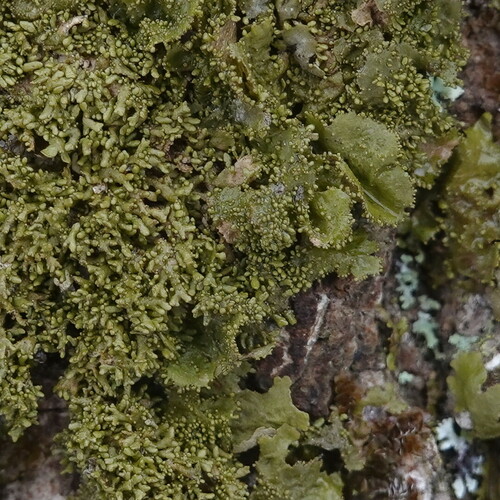
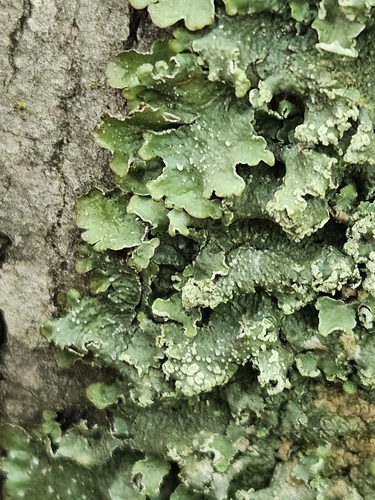
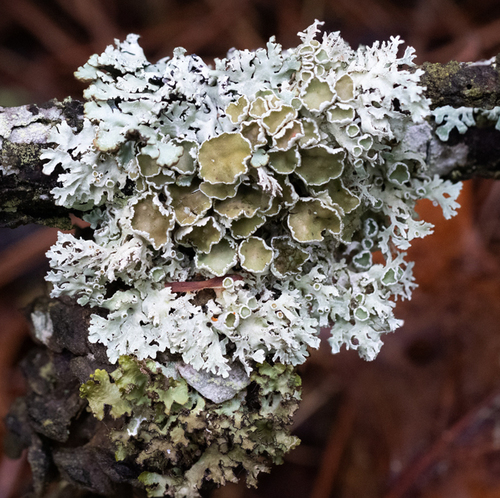
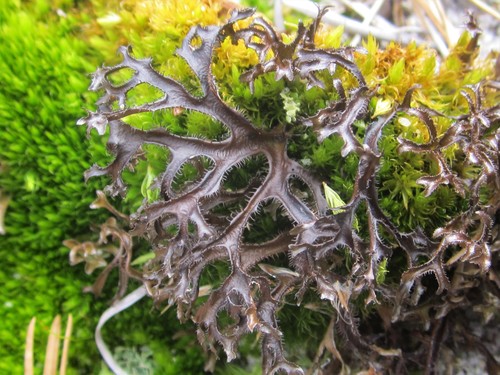
Cetraria arenaria Kärnef. has a thallus that ranges in color from gray-olive to olive-brown. It is made up of regularly branched, flat or curled lobes that measure 1–4 mm wide. The lobes bear pseudocyphellae, which are pores on the cortex; these structures are either broad and located along lobe margins, or irregularly shaped, depressed into the cortex, and distributed across the entire thallus surface. Fruiting bodies called apothecia occur rarely in this species. They have a reddish-brown disc and develop along the expanded tips of the lobes. This lichen produces asci that measure 35 to 50 micrometers (μm) in length and 10 to 12 μm in width. Its spores are ellipsoidal, 5.5 to 6 μm long and 3.5 to 4 μm wide, and contain an axial body approximately 1 μm thick. The maximum thickness of the tholus, the thickened portion of the ascus apex, is around 2.5 μm. Paraphyses, the sterile filamentous structures found among the asci, measure 40 to 50 μm in length and 1 to 2 μm in width. This lichen also has cortical tissue beneath its pycnidia, the specialized structures that produce asexual spores called conidia. The conidia are oblong and lemon-shaped (citriform), measuring about 5 μm in length and 1 μm in width. Cetraria arenaria occurs in temperate lowland regions of North America, where it grows in sandy soils or thin soil layers overlying bedrock. Its range extends from the New England states across to the Northern Great Plains, and it is not uncommon in these specific habitats.