About Cestrum aurantiacum Lindl.
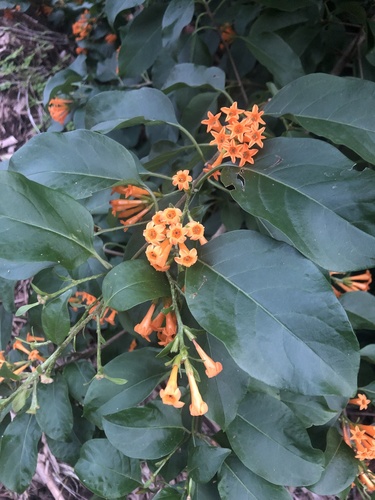
Cestrum aurantiacum Lindl. is a shrub that typically grows 1.5 to 6.5 m tall, and may occasionally reach up to 8.5 m in height. Its branches are either glabrous or sparsely tomentose. The leaves are ovate to elliptical, measuring 7 to 17 cm long and 2.5 to 5.5 cm wide. Both leaf surfaces are glabrous; the leaf tip is acuminate or shortly tapering, while the leaf base ranges from acuminate to blunt, and is occasionally shortly tapering. The glabrous petioles are 1 to 3 cm long. This species is distributed across a range extending from southern Mexico to Nicaragua. It grows in moist thickets or forests, most often in pine-oak forests, at altitudes between 1000 and 2600 m. This plant is cultivated as an ornamental, and it is poisonous if eaten by animals. Despite its toxicity, it is widely grown as an ornamental, and has escaped from cultivation to grow in the wild in some regions. In parts of Africa, Asia, and Australia, it has become a harmful invasive species. The aboveground portion of the plant is hardy to zone 8, while its roots are hardy to zone 7. It is drought tolerant, and grows best in occasionally moist, humus-rich, well-drained soil in full sun or partial shade. The size of this shrub can be easily controlled via pruning. It is considered to have medicinal uses in Peru. Its flowers attract hummingbirds, butterflies, and other pollinating insects.