About Certhidea olivacea Gould, 1837
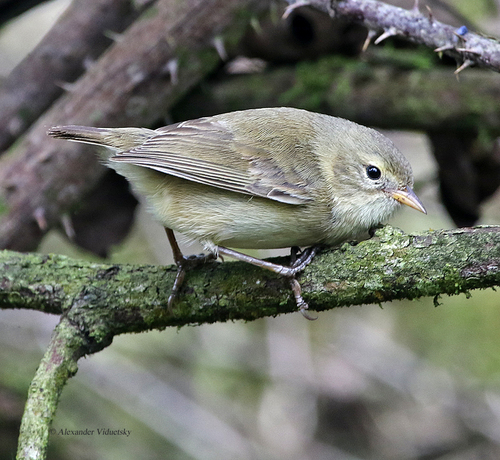
The green warbler-finch (Certhidea olivacea) is a species of Darwin's finch, a group of birds in the tanager family Thraupidae. While it was sometimes previously classified in the family Emberizidae, more recent studies confirm its placement in Thraupidae. When Charles Darwin collected this species in 1835 during the Beagle survey expedition, he mistakenly identified it as a wren. After Darwin returned to England, ornithologist John Gould informed him in March 1837 that this bird actually belonged to the group of Galápagos finches. This species is endemic to the Galápagos Islands of Ecuador. It is closely related to the grey warbler-finch; the two were formerly considered the same species, but they now are recognized as separate due to differences in appearance, distribution, habitat, and song. Warbler-finches hold a distinctive place in the evolutionary history of Galápagos finches. Phylogenetic studies indicate that this group represents one of the earliest branches in the adaptive radiation of Galápagos finches, diverging before the more widely known ground finches and tree finches. The green warbler-finch has a slender, pointed beak adapted for capturing insects, giving it a unique ecological niche within the Galápagos archipelago, making it a key species for studying the evolutionary processes that produced the notable avian diversity of this iconic ecosystem. The green warbler-finch uses its sharp beak to access a range of food sources. Its diet is made up mainly of insects, seeds, and small fruits. The insects it consumes include caterpillars, beetles, and ants, and it also eats spiders. It tends to eat more insects during the summer, and more seeds, fruits, and berries during the winter. It forages for food either alone or in small groups. Only one subspecies of green warbler-finch is recognized: the nominate subspecies C. o. olivacea, which is found on the Galápagos islands of Santiago, Rábida, Pinzón, Isabela, Fernandina, and Santa Cruz. Its natural habitats are subtropical or tropical dry forests, subtropical or tropical moist montane forests, and subtropical or tropical dry shrubland. It is most commonly found on larger Galápagos islands, is most abundant in humid, high-elevation areas, and is less abundant in low-elevation, dry locations. The green warbler-finch is monogamous, often forms long-term pair bonds, and defends a small breeding territory. It typically breeds during the hot wet season, when insect prey is abundant. The male builds a spherical nest from dry grasses, moss, and lichens, and places the nest on small branches. The female lays 3 to 5 white eggs with reddish-brown spots, and incubates the eggs alone for approximately 12 days. The young chicks leave the nest just two weeks after hatching, which supports the species' reproductive success.