About Certhiaxis cinnamomeus (Gmelin, 1788)
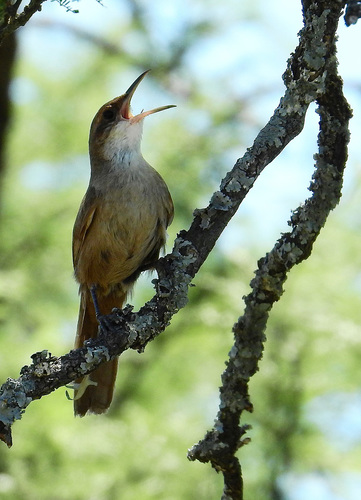
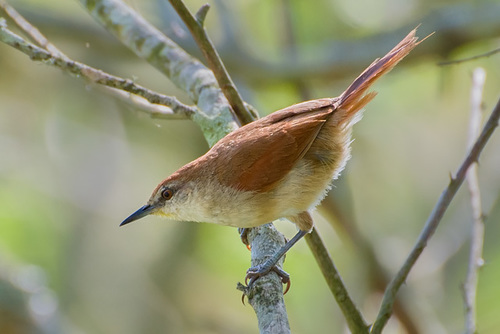
The yellow-chinned spinetail, scientifically named Certhiaxis cinnamomeus (Gmelin, 1788), is typically 15 cm long and weighs 15 g. It is a slender bird with a long tail. Its upperparts and head are chestnut brown, and its underparts are whitish, with the exception of its pale yellow throat. The sexes of this species look similar, but there are multiple subspecies that differ in forecrown colour or the tone of their upperparts. Its call is a shrill rattling.
The yellow-chinned spinetail is found across all contiguous regions of Brazil, except for specific areas of the Amazon Basin. In northern South America, the species occurs mainly along the coast, in a continuous coastal strip that extends from the mouth of the Amazon River through Amapá state in northern Brazil, the Guianas, reaching all the way to the headwaters of the south-flowing Branco River in north-central Roraima state, Brazil where it borders the Guiana Highlands. Its range extends more widely inland along the Orinoco River in Venezuela, and reaches northern Colombia where it extends up the Madeira River valley beyond the Serranía de las Quinchas. Further south, like its sister species the red-and-white spinetail (C. mustelinus), it is found along the Amazon River corridor. After the upper Amazon exits the Andes, it only occurs in the river corridor, then splits to go up the Madeira River, moving southwest into Bolivia. From Bolivia, its range extends along the Andean foothills to northwestern Argentina, Paraguay, Uruguay, and finally the Rio de la Plata. The species is apparently absent from most of Pará and northern Mato Grosso states, the area that lies between the Madeira and Araguaia River corridors. Apart from this absent region, it occurs across most of South America in the area enclosed, running counterclockwise, by the lower Amazon, the Madeira River, the Andes, the Paraguay River, the lower Paraná River, and the Atlantic Ocean.
This species is a common resident breeder in marshes and the edges of mangrove swamps. In general, its habitat is open woodland located near rivers. The yellow-chinned spinetail feeds on insects and spiders, staying low and often foraging in the open. It is a conspicuous, confiding, and noisy bird. Unlike related ovenbirds, the yellow-chinned spinetail builds a large spherical stick nest, usually placed low in a mangrove or other marsh vegetation. A tubular entrance tunnel rises almost vertically from the base to the top of the nest. The normal clutch is three, sometimes four, greenish white eggs. This spinetail is parasitised by the striped cuckoo (Tapera naevia), which lays one or two eggs in the spinetail's nest. It is not known how the cuckoo enters the nest, or whether the cuckoo or its cuckoo offspring eject the host's young. This widely distributed bird is not considered threatened by the IUCN.