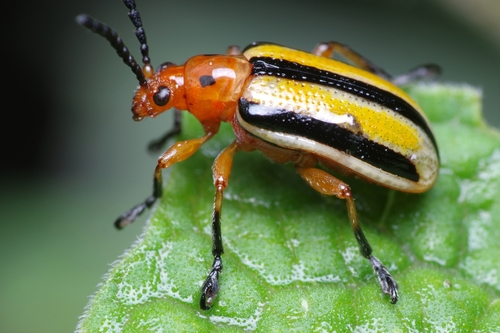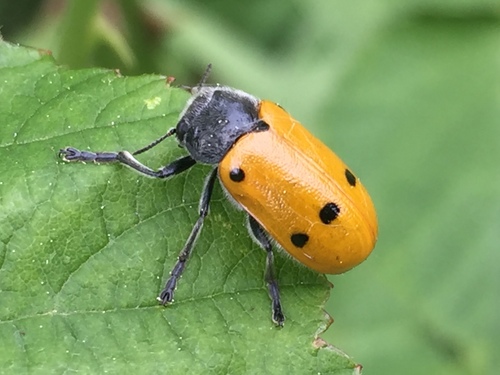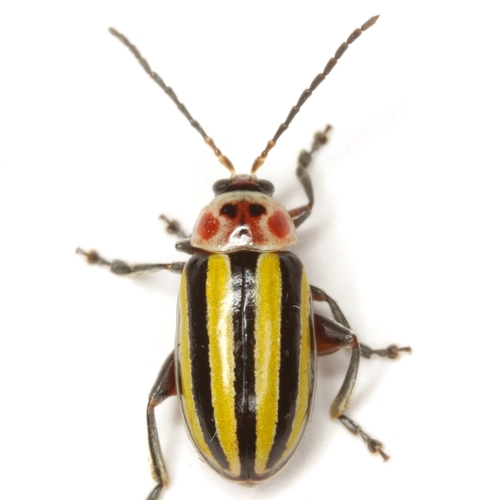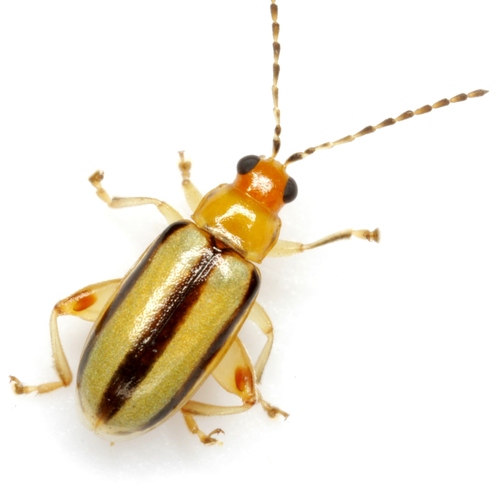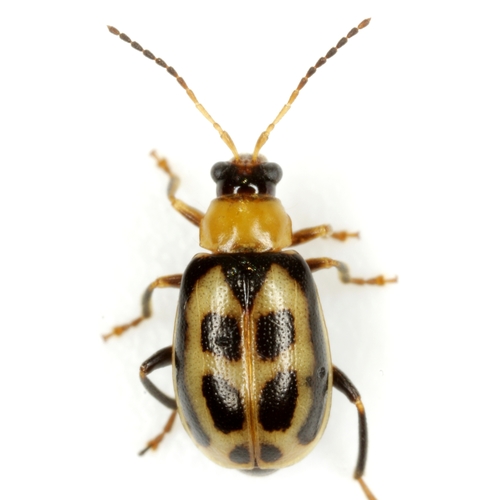
About Cerotoma trifurcata (Forster, 1771)
Cerotoma trifurcata, commonly known as the bean leaf beetle, is a species of leaf beetle belonging to the Chrysomelidae family, found in the Eastern and Western United States. It was previously classified as a minor pest, but its population abundance has increased over the past 30 years. It has spread from its native range in the Mississippi Delta into the American Midwest and Canada. C. trifurcata prefers soybeans as a host plant, but it has also been recorded on alfalfa, cowpea, snap beans, and cucurbits. It causes crop damage through direct feeding damage to pods, and also acts as a vector for bean pod mottle virus. This beetle species overwinters as adults. Overwintering is linked to mating behavior, and controls the timing of egg laying by the beetle. A 2001 study by Lam and Pedigo investigated bean leaf beetle feeding preferences, and found that the beetles prefer to feed on soybeans with lower trichome density. Trichomes, also called plant surface hairs, act as a plant defense that interferes with insect movement, and reduces insects' access to the leaf epidermis. Most soybean cultivars grown in the United States have simple trichomes. Imm soybeans have higher trichome density, and this density decreases as the beans mature. In the study, soybean cultivars that lose trichome density as they mature experienced increased feeding by C. trifurcata. By contrast, soybean cultivars that retained higher trichome density experienced less feeding by the beetle. Lower levels of feeding also led to less inoculation of pathogens including bean pod mottle virus and fungi. The study suggests that higher trichome density could be bred into soybean cultivars as a method to reduce feeding damage caused by C. trifurcata.